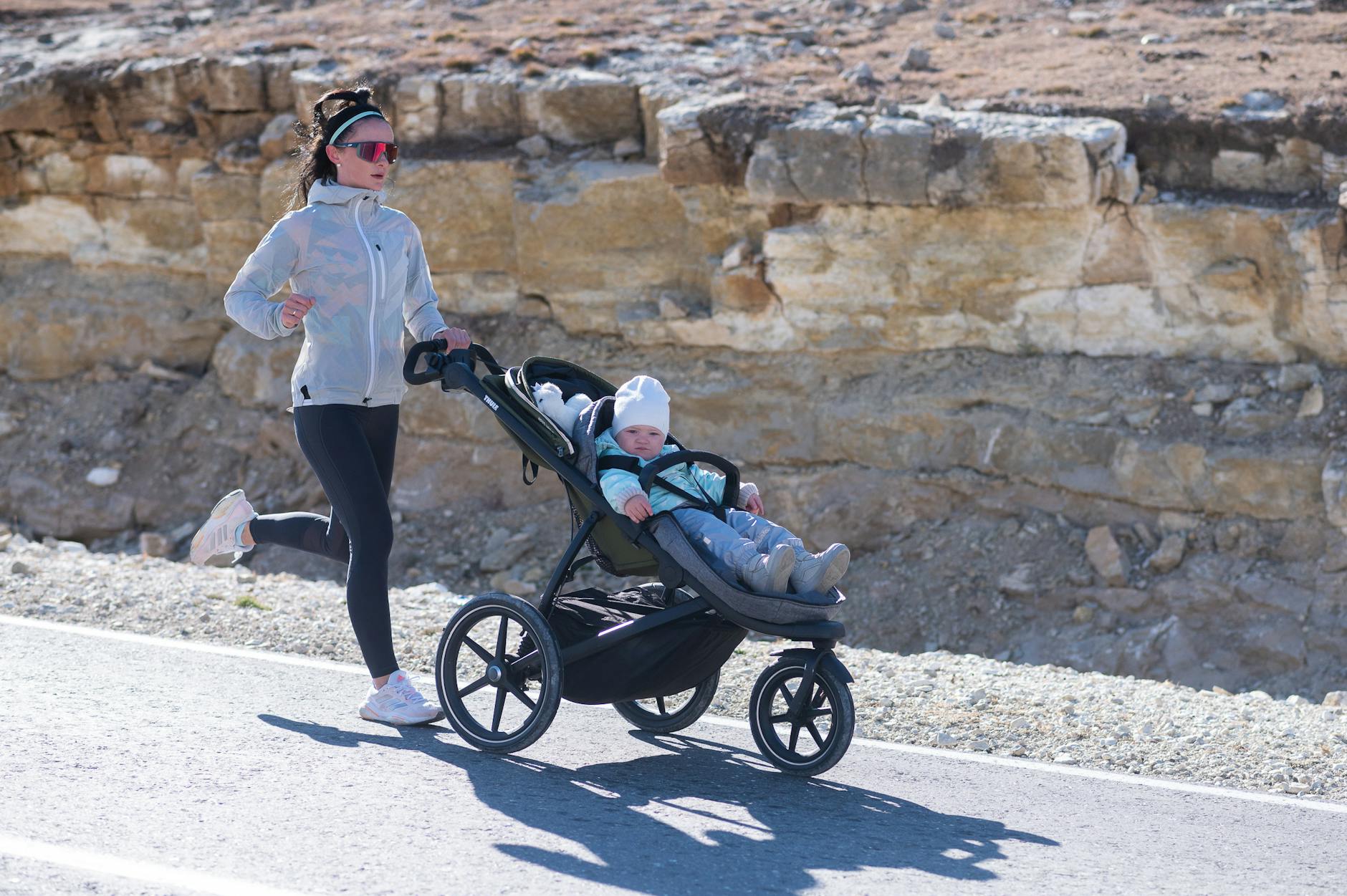
Photo by Dmitrii Eremin on Pexels
You were a runner before. You’re still a runner. But right now your body has been through something significant — and the six-week GP sign-off that supposedly clears you to “return to normal activity” doesn’t tell you nearly enough about what that means for running specifically.
The gap between “cleared for exercise” and “ready to run” is bigger than most new parents are warned about. Getting that wrong — going out too soon, ignoring signals from your body, or trying to return at the pace you ran before — is one of the most common causes of long-term pelvic floor problems, prolapse symptoms, and running injuries in postpartum women. None of that means you should be scared to run. It means you should be smart about it.
This guide walks you through what’s actually happening in your body, what the research says about timing, and how to build back in a way that gives you the best chance of running well for years to come — not just getting through a 5K in the next few weeks.
Why six weeks isn’t the magic number
The standard six-week postnatal check was designed to assess your general health, not your readiness to run. Running is a high-impact activity that places 2.5 times your bodyweight through your pelvis with every footstrike. Your pelvic floor, abdominal muscles, and connective tissue are still rebuilding at six weeks — whether you had a vaginal birth or a caesarean section.
The 2019 guidelines from Groom, Donnelly and Brockwell, published in the British Journal of Sports Medicine, recommend waiting until at least 12 weeks postpartum before returning to running — and only after you can pass key physical benchmarks. These aren’t arbitrary. They’re based on the healing timeline for the pelvic floor and the relaxin hormone (which keeps ligaments lax for months after birth) still being present in your system while breastfeeding.
If you had a perineal tear, episiotomy, or c-section, the timeline extends further. This isn’t about being overcautious. It’s about not trading a good three months of patience for years of symptoms.
What to do in weeks 1–12 before you run
The temptation to get back out there is real — especially if running was your stress release. But these early weeks aren’t dead time. They’re the foundation.
Weeks 1–6: rest, breathe, and reconnect
– Focus on diaphragmatic breathing and gentle pelvic floor activation. These aren’t “exercises” in the traditional sense — they’re reconnecting with muscles that have been under enormous stress.
– Walking is your training. Start with short, flat walks (10–15 minutes) and build gradually.
– Avoid anything that causes pressure, heaviness, or leaking.
Weeks 6–12: build load and test readiness
– Progress walking to 30 minutes at a brisk pace with no symptoms.
– Introduce bodyweight strength: glute bridges, clamshells, single-leg work. Your hips and glutes carry a huge share of running load — if they’re weak, your pelvic floor picks up the slack.
– Check in with a women’s health physiotherapist if you can. Even one appointment can tell you more about your readiness than anything you’ll read online, including this.
The readiness checklist before your first run
Before you lace up and go, you should be able to do all of the following without leaking, pain, pressure, or heaviness in your pelvic floor:
| Test | Target |
|---|---|
| Walk briskly for 30 minutes | No symptoms |
| Single-leg balance (10 seconds each side) | Stable and controlled |
| Single-leg calf raise (10 reps each side) | No pain or weakness |
| Jog on the spot for 1 minute | No leaking or pressure |
| Low-impact skipping (1 minute) | No symptoms |
| Single-leg hop (10 reps each side) | Controlled landing |
If you can’t get through that list symptom-free, you’re not ready to run yet — and pushing through won’t speed things up. Spending another two to four weeks on walking and strength will get you there faster than limping through a run that sets you back.
How to structure your return to running
Once you pass the checklist, start with run/walk intervals — not a continuous 5K. Your cardiovascular fitness may return quickly, but your tendons, ligaments, and pelvic floor need progressive loading. The two aren’t the same clock.
A sensible starting point at 12–14 weeks postpartum (assuming you pass the readiness tests):
| Week | Session structure | Frequency |
|---|---|---|
| 1 | 1 min run / 2 min walk × 8 | 3x per week |
| 2 | 1.5 min run / 2 min walk × 8 | 3x per week |
| 3 | 2 min run / 1 min walk × 8 | 3x per week |
| 4 | 3 min run / 1 min walk × 7 | 3x per week |
| 5–6 | 5 min run / 1 min walk × 5 | 3x per week |
| 7–8 | Continuous 20–25 min easy run | 3x per week |
Keep your pace conversational throughout — you should be able to speak in full sentences. If you’re breathless, slow down further. Around 6:00–7:00/km is a reasonable target for most returning runners, but your body will tell you more than any number.
Symptoms that mean you need to stop and get checked
This list isn’t meant to scare you, but it’s important. Stop running and see a women’s health physiotherapist if you experience:
- Leaking (urine or bowel) during or after running
- Heaviness or dragging in your pelvis — this can be a sign of prolapse
- Pelvic or hip pain that doesn’t resolve within 24 hours
- Diastasis recti symptoms — a visible dome or gap along your midline when you sit up, or feeling like your core “collapses” under load
None of these mean you’ll never run again. They mean you need support before continuing, not instead of running permanently.
The NHS has clear guidance on pelvic floor health after birth, including what symptoms to report and when to seek referral.
Running and breastfeeding: what you actually need to know
Running while breastfeeding is absolutely possible, and for most people isn’t a problem. A few practical points:
- Relaxin stays elevated while you’re breastfeeding, which means your joints remain more lax than pre-pregnancy. This isn’t a reason to stop, but it’s a reason to be thoughtful about increasing intensity or mileage too quickly.
- Feed before you run if you can — full breasts are uncomfortable to run with and a good sports bra becomes even more important than usual. Invest in one that actually fits your current size, not your pre-pregnancy one.
- Hydration matters more — you’re already losing fluid through milk production. Drink before, during, and after runs.
- Lactic acid can temporarily change the taste of breast milk immediately after high-intensity effort — if this is something you’re monitoring, low-to-moderate intensity runs are unlikely to be an issue.
A note on the mental side of returning to running
Your fitness will take time to come back. Your body looks and feels different. You might run slower than before, get tired faster, or find that a 20-minute run wipes you out in a way it never did. That’s not weakness — that’s reality.
Progress in the early weeks is rarely linear. One good run followed by a harder one doesn’t mean you’re going backwards. Sleep deprivation, hormonal shifts, and the sheer weight of new parenthood affect how your body performs. Comparing your current runs to pre-pregnancy PBs isn’t fair to yourself, and it’s not a useful measure of progress.
What’s worth tracking: can you run further than last week without symptoms? Is your recovery time getting shorter? Are you enjoying it more? Those are the signals that matter right now.
The Honest Takeaway
- Don’t rely on the six-week clearance as a green light to run. A check with a women’s health physio at 8–12 weeks gives you far more useful information.
- 12 weeks postpartum is the recommended minimum before returning to running — and only if you can pass the physical readiness benchmarks without symptoms.
- Use a run/walk structure for at least 6–8 weeks after returning, regardless of how fit you feel. Your tendons and pelvic floor need progressive loading, not a sudden return to volume.
- Leaking, heaviness, or pelvic pain are not things to push through. They’re signals to get support before continuing.
- Be patient with your pace and your body. Most runners who return carefully are back to regular training by 6–9 months postpartum. Most who rush it take longer — or deal with ongoing symptoms that make running harder for years.