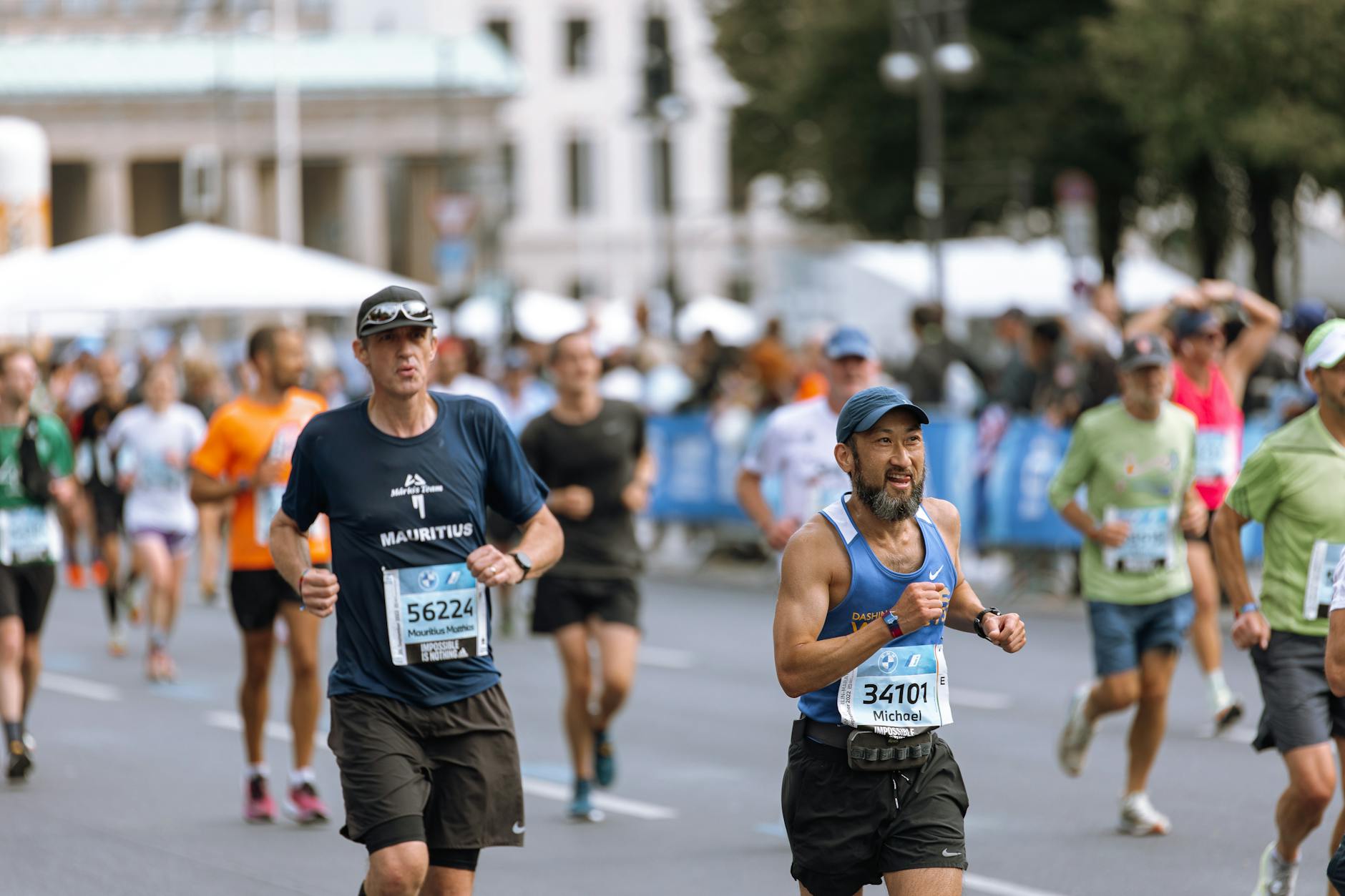
Photo by José Pablo Domínguez on Unsplash
Fueling during a marathon is simple: 30–60g carbs per hour, starting at km 5, every 45 minutes. Most runners overthink it and either bonk or upset their stomach.
This is what works.
Why You Need to Fuel
Your muscles store roughly 1,800–2,000 calories of glycogen (carbs). A marathon burns 2,400–3,000+ calories depending on your pace and weight.
Do the math: you don’t have enough glycogen to finish. You need external fuel.
At km 30 (after ~2.5 hours), your glycogen is nearly depleted. If you haven’t fueled, your legs feel like concrete and your pace collapses. This is “bonking” or “hitting the wall.”
Fueling every 45 minutes prevents this. You’re topping up your glycogen tank before it empties.
The Fueling Timeline
Km 0–5: Water only
Your stomach is still settling. Your body has plenty of glycogen. Taking a gel at km 2 often causes nausea.
Km 5–30: 1 gel + water every 45 minutes
– Km 5: Gel #1 + 200–250 mL water
– Km 9.5–10: Gel #2 + water
– Km 14–15: Gel #3 + water
– Km 19–20: Gel #4 + water
– Km 24–25: Gel #5 + water
– Km 29–30: Gel #6 + water
Km 30–42.2: Continue every 45 min, or shift to sports drink at aid stations
Your glycogen is nearly gone. You’re running on fumes and fuel. Keep taking gels if you can, or switch to liquid calories at aid stations.
How Much Fuel?
1 energy gel = 20–30g carbs (check the package). Your target is 30–60g carbs per hour.
At 10K/hour pace (your km 5, km 10, km 15 timing):
– 1 gel every 45 min = 26–35g carbs per 45 min = 35–47g per hour. Perfect.
At 8:30/km pace (faster marathoner):
– Km 5 to 9:30 = 45 min, take 1 gel
– Same timing works
The key: take a gel every 45 minutes, drink water. Adjust if your stomach rebels (more on that below).
Energy Gel Comparison
| Gel Type | Carbs | Caffeine | Best For | Notes |
|---|---|---|---|---|
| Standard gel (GU, Gu2O) | 20–24g | 0–40mg | Most runners | Smooth, easy to swallow |
| Caffeinated gel | 20–24g | 40–100mg | Afternoon/evening races | Provides mental boost at km 25+ |
| Electrolyte gel | 20g | 0mg | Hot races | Contains sodium, helps hydration |
| Real food gel | 20–30g | 0mg | Prefer natural | Dates, honey-based. Digests faster |
| Liquid gel | 20g | 0mg | Prefer less chewing | Applesauce pouches, liquid carbs |
Most runners go with standard gels (GU, Hammer Gel, Huma, Maurten). They work. Don’t overthink the brand.
Hydration Alongside Gels
Gels are concentrated carbs. They need water to digest properly.
With each gel:
– Take the gel (chew it or squeeze it—both work)
– Drink 200–250 mL water (about one cup)
At aid stations (between gels):
– Drink 200–250 mL water or sports drink
Total fluid goal: 500–750 mL per hour.
This combination (gel + water, water at station, gel + water) keeps you hydrated and fueled without overloading your stomach.
Common Gel Mistakes
1. Not practicing in training
You buy gels for race day and take one for the first time at km 7. Your stomach rebels. Don’t do this.
Take the exact gel you’ll use in the race on 3–4 long training runs. Your digestive system needs to know what to expect.
2. Taking gels without water
A gel with no water sits heavy in your stomach. Water helps it move through and absorb.
3. Taking gels too frequently
Every 30 minutes instead of 45. You’re overloading your stomach and potentially causing nausea.
4. Switching gels mid-race
You trained on GU but the aid station has Hammer Gel. Your stomach doesn’t know Hammer. You feel nauseous at km 25.
Ask the race organizer what gels they provide, then train on those gels beforehand.
5. Ignoring your fueling plan
You get to km 20, feel okay, skip a gel. Then km 28 hits and you bonk hard. You didn’t “feel” like needing fuel, but your muscles were depleting glycogen anyway.
Fuel on schedule, not on feel.
Caffeine in Gels
Late-race (km 25+), a caffeinated gel provides a mental and physical boost.
Caffeine:
– Improves alertness when you’re fading
– Provides small performance benefit (1–3% faster pace)
– Can help prevent or reduce perceived pain
Use 1 caffeinated gel around km 25–30. More than one can cause jitters.
If you’re sensitive to caffeine, skip it. It’s not essential.
Alternatives to Gels
Some runners can’t tolerate gels. Alternatives:
Energy chews (Clif Shot Blocks, GU Chews):
– 20–30g carbs, you chew them
– Feel more like real food
– Easier for some stomachs
– Need water to help digest
Real food (bananas, pretzels):
– Bananas at aid stations provide 20–25g carbs
– Pretzels provide carbs + salt
– More satisfying psychologically
– Slower to digest; need water
Sports drink (Gatorade, Powerade):
– 30–50g carbs per liter depending on concentration
– Provides hydration + fuel at once
– Can cause nausea if too concentrated
– Softer on stomach than gels for some runners
Mix and match what works. Some runners do: 2 gels + 1 banana + sports drink at station.
Practice Plan for Race Prep
Long run 1 (Week 12): Try your race-day gel. 1 gel at km 10, 1 at km 15. Water with each.
– Assessment: stomach okay? Pace okay? Energy level?
Long run 2 (Week 13): Full fueling plan. Gel every 45 min for the entire run.
– Assessment: can you sustain this? Any stomach issues?
Long run 3 (Week 14): Same fueling plan. This is your dress rehearsal.
– Note: timing, gels used, any issues
Long run 4 (Week 15, race preview): Simplified fueling (maybe 2–3 gels). Practice the logistics.
By race day, you’ve fueled on the exact gels 4+ times. Your stomach knows what to expect.
Race Day Execution
Carry gels in your pockets or a small belt. Or rely on aid stations (but confirm they have gels beforehand).
With each aid station:
1. Take a gel from your pocket or grab one from the station
2. Eat the gel
3. Drink water or sports drink
4. Keep moving
Don’t stop. Walk if you need to, but keep moving. Standing around makes you stiff.
When to Stop Fueling
Most runners can stop taking gels around km 35. By then, you’re consuming fuel mainly for morale, not fitness.
The last 7K is survival pace. You’re not getting faster; you’re maintaining pace with whatever legs you have left.
Some runners take a final gel at km 35–36 for a mental boost. Most just focus on getting to the finish.
The Honest Takeaway
Fueling a marathon is straightforward: 1 gel every 45 minutes starting at km 5, with water.
- Practice your fueling plan on 3+ long training runs — no surprises on race day
- Gel every 45 minutes — 30–60g carbs per hour
- Water with every gel — needed for digestion and absorption
- Use the exact same gels as race day — your stomach matters more than brand loyalty
- Fuel on schedule, not on feel — you need fuel before you feel depleted
The runners who bonk at km 30 didn’t have adequate fitness—they had inadequate fueling. The runners who finish strong are usually the ones who fueled consistently and hydrated well. It’s unsexy and unglamorous, but it’s the difference between a good marathon and a nightmare.
Sources:
– Journal of the International Society of Sports Nutrition: Carbohydrate Intake During Exercise
– Sports Medicine: Gastrointestinal Issues and Endurance Running Fuel