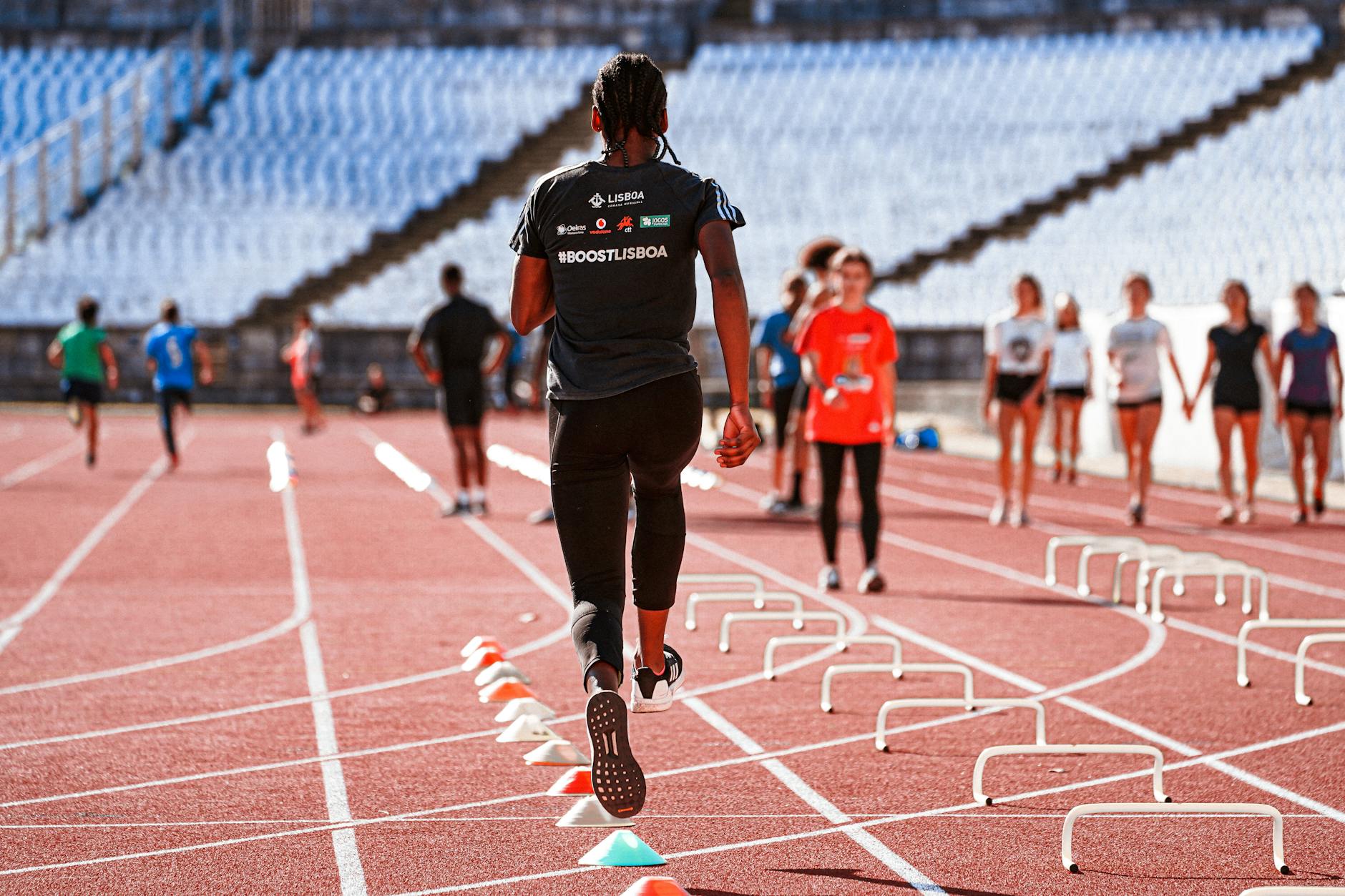
Running cadence is how many steps you take per minute. Most recreational runners land at 160–170 steps per minute. Elite runners often run 180+. The difference: higher cadence means shorter strides, which means less impact and often faster pace.
But cadence isn’t universal. A 165 cadence might feel comfortable and fast. A 185 cadence might feel choppy and unnatural. The goal isn’t to force 180 steps per minute—it’s to find your optimal cadence, which is usually higher than what you’re currently doing.
Increasing cadence by 5–10% (roughly 10–15 steps per minute) is the sweet spot: you run faster, impact decreases, and it doesn’t feel awkward.
Why Higher Cadence Helps
Shorter, quicker steps = less braking impact on each footfall.
Think of it this way: running 10 km at 160 cadence vs. 180 cadence.
At 160 cadence: larger steps, longer ground contact, higher impact forces
At 180 cadence: smaller steps, quicker turnover, lighter impact per footfall
Faster cadence also forces you to run more upright (less overstriding), which reduces injury risk for knees and shins.
Research shows that increasing cadence by 10% reduces impact forces by 16%. That’s significant for injury prevention.
Finding Your Current Cadence
Count your steps for 60 seconds while running at easy pace.
Use a metronome app or simply count: “one-two-three…” every time your left foot lands, then multiply by two (since you step twice per revolution).
Or wear a watch that displays cadence. Most modern running watches show it.
Most recreational runners land at:
– 160–170 steps per minute (probably too slow)
– Optimal range: 170–185 for most runners
– 180+ is elite-runner territory
If you’re at 160–170, increasing to 175–180 is a realistic, safe target.
Cadence Drill 1: Metronome Running
This is the foundation. You’ll literally run to a beat.
- Download a metronome app (Metronome Beats, Simple Metronome, or any running app)
- Set it to 170 bpm (beats per minute)
- Run easy for 10 minutes, matching the beat with your footfalls
Feel: It feels fast at first. After 5–10 minutes, your body adjusts. It starts feeling natural.
Week 1: 2 sessions at 170 bpm
Week 2: 2 sessions at 172 bpm
Week 3: 2 sessions at 175 bpm
Week 4: 2 sessions at 180 bpm
Do one metronome session per week, 10–20 minutes at a time. Don’t overdo it—it’s cognitively demanding to match a beat.
Cadence Drill 2: Stride Cadence Intervals
Run short intervals at higher cadence, then recover.
Workout: 10 min easy warm-up, then:
– 3 min at 175 cadence (easier effort)
– 2 min easy recovery (normal cadence)
– 3 min at 180 cadence (push effort)
– 2 min easy recovery
– 3 min at 180 cadence (hold it)
– 10 min cool-down easy
Total: 35 minutes
This teaches your neuromuscular system to handle higher cadence at different paces. Your legs learn the faster turnover.
Do this once per week for 3–4 weeks.
Cadence Drill 3: Uphill Running
Uphill naturally increases cadence. Run a 2–3% grade hill at comfortable effort.
Your body automatically takes shorter, quicker steps uphill. You can’t overstride uphill without destroying your quads.
Workout:
– 10 min easy warm-up on flat
– 5 × 2 min uphill (comfortable effort) with 1 min recovery jog downhill
– 5 min cool-down easy
Do this once per week. The uphill trains cadence; the downhill recovery lets you learn how to maintain it.
Cadence Drill 4: Quick Feet Drills
Dynamic drills that improve cadence directly. Do these 1–2 times per week before a run as part of warm-up.
High Knees (2 × 30 seconds):
Run in place, drive your knees up to hip height, land quickly. Fast, explosive, light on your feet.
Butt Kicks (2 × 30 seconds):
Run in place, kick your heels up to your glutes. Quick, snappy, high turnover.
Bounding (2 × 30 meters):
Exaggerated running where you bound forward with each stride, covering distance explosively. Land, bound again. This is like plyometric running.
Ladder Drills:
If you have access to a agility ladder, quick footwork through the ladder (one foot per square, two feet per square, lateral movement) teaches coordination and rapid turnover.
Do 5–10 minutes of these before your runs. They activate your fast-twitch muscles and prime your nervous system for quick cadence.
Form Cues to Support Higher Cadence
1. Shorter stride
Take smaller steps. Land directly under your hip (or slightly in front), not far in front of your body. This naturally increases cadence.
2. Lean from ankles, not hips
Bend forward from your ankles/lower body, not from your waist. This keeps you upright and naturally quickens your pace.
3. Relax your shoulders
Tension slows you down. Relaxed arms and shoulders let your legs move freely.
4. Quick arm swing
Your legs follow your arm rhythm. Quick, efficient arm swing (90-degree bend) encourages quick leg turnover.
5. Land lightly
Imagine running on hot coals. Quick, light footfalls. Heavy, pounding steps = slow cadence.
Cadence by Running Speed
Higher cadence at different speeds:
| Running Speed | Cadence (slow) | Cadence (target) |
|---|---|---|
| Easy (10:00/km) | 160–165 | 170–175 |
| Steady (8:30/km) | 168–172 | 175–180 |
| Fast (7:00/km) | 175–180 | 180–185 |
| Racing (5:50/km) | 180–185 | 185–190 |
Notice: as you get faster, cadence naturally increases. You’re not forcing it; it happens.
When NOT to Increase Cadence
If you’re injured (knee, shin, ankle pain) — talk to a physio before adding cadence drills
If you’re already at 180+ — you might already have optimal cadence; forced increases can cause injury
If increasing cadence causes pain — back off; your body isn’t ready
Cadence improvement should feel natural, not forced. If it hurts, stop.
Expected Timeline
Week 1–2: Cadence feels fast and awkward. Your legs feel heavy.
Week 3–4: Cadence feels more normal. You notice less impact on your knees and shins.
Week 5–6: Higher cadence becomes your default. You don’t have to think about it.
Week 7+: Faster pace feels easier at higher cadence. You naturally prefer the quicker turnover.
Most runners see measurable cadence improvement within 4–6 weeks of consistent drills.
The Honest Takeaway
Cadence improvement is one of the highest-ROI training changes. Higher cadence = less impact, faster pace, fewer injuries.
- Metronome running teaches the beat — 1–2 sessions per week, 10–20 minutes
- Uphill running builds cadence naturally — easier than forced metronome work
- Quick-feet drills activate fast-twitch muscles — 5–10 minutes pre-run
- Shorter strides support higher cadence — land under your hip, not in front
- Expect 4–6 weeks to feel natural — don’t force it faster than that
The runners who improve their cadence don’t become instantly faster. But after 6 weeks, they realize they’re running faster at the same effort level, with fewer knee and shin complaints. That’s the real win of cadence training.
Sources:
– Journal of Biomechanics: Impact Forces and Cadence in Running
– Medicine and Science in Sports and Exercise: Cadence and Running Economy