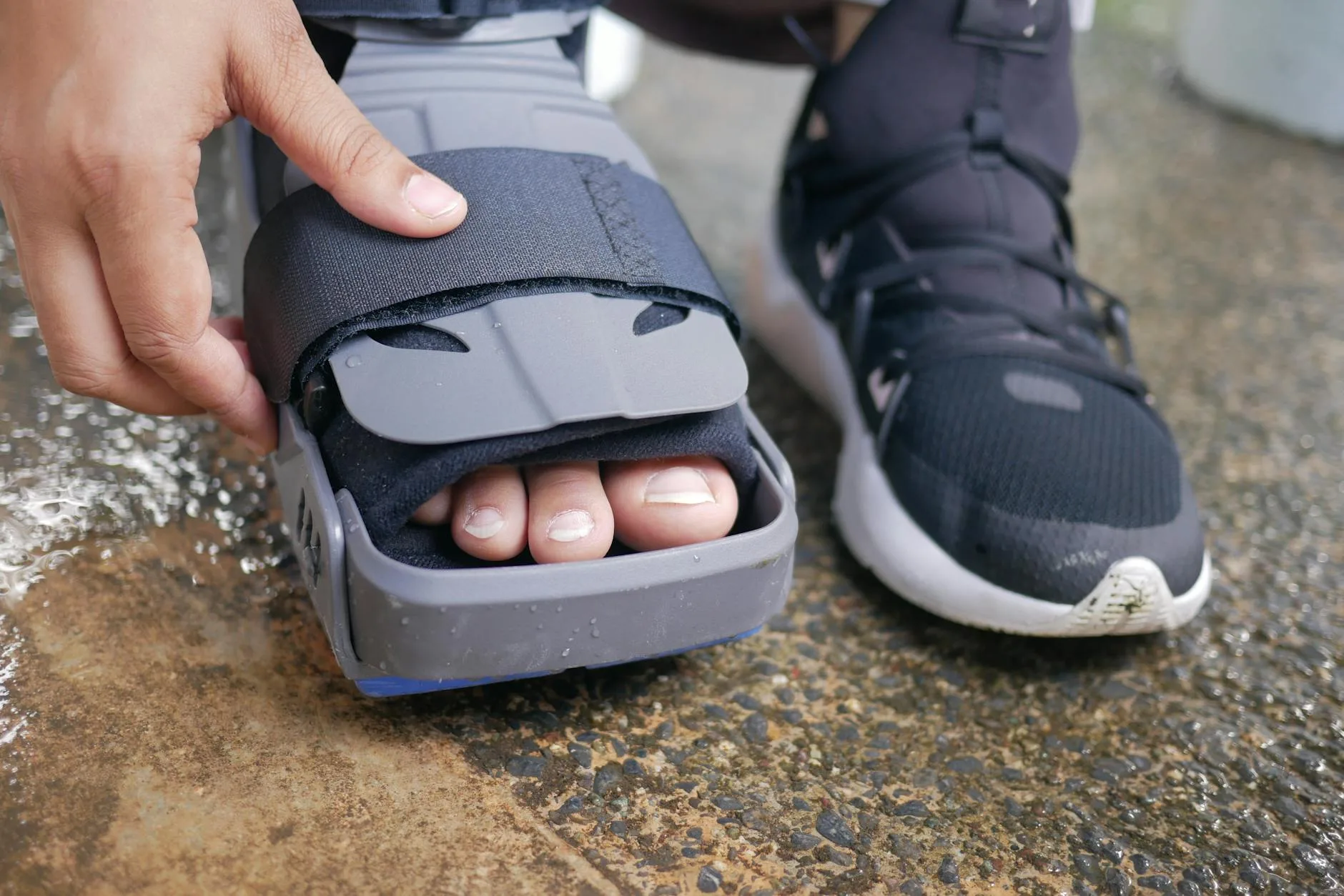
Photo by Towfiqu barbhuiya on Pexels
There’s a particular kind of pain that runners learn to push through — the tight calves, the stiff hip, the blister forming by kilometre three. But there’s another kind of pain that doesn’t follow that script. It gets worse as you run, not better. It shows up in the same exact spot every time. And deep down, you already know something isn’t right.
A stress fracture is one of the more serious injuries a runner can pick up, but it’s also one of the most commonly ignored — partly because the early signs are easy to dismiss as “just” shin splints or general soreness, and partly because no one wants to accept that they need to stop running for weeks. If you’re reading this, you’re probably trying to work out whether what you’re feeling is serious, or whether you can train through it. This article will give you an honest answer.
What follows isn’t designed to replace a physio or GP visit — you’ll need one if this applies to you. But it will tell you what to look for, what typically happens during recovery, and how to come back without making the same mistake twice.
What is a stress fracture, exactly?
A stress fracture is a small crack in the bone caused by repetitive loading rather than a single traumatic impact. Your bones are constantly remodelling — breaking down and rebuilding — in response to the forces placed on them. When you increase training load faster than your body can adapt, that remodelling process falls behind, and a tiny crack can form.
Runners most commonly get stress fractures in the tibia (shin), metatarsals (the long bones in the foot), the fibula (outer lower leg), the navicular (a small bone in the midfoot), and the femur (thigh). The tibia accounts for roughly 50% of running-related stress fractures. The navicular and femoral neck fractures are rarer but more serious — they need quicker medical attention and can require surgery if missed.
Stress fractures are not the same as stress reactions. A stress reaction is an earlier stage of bone stress — the bone is under strain but hasn’t cracked. Caught early, a stress reaction heals faster. Ignore it, keep running, and it becomes a full fracture.
The signs you need to take seriously
Most stress fractures follow a recognisable pattern. Not all of them tick every box, but if several of these match your situation, it’s time to stop guessing and get it checked.
Pain that worsens during a run. Normal muscle soreness eases off after the first 10–15 minutes of running. Stress fracture pain typically builds as you continue, sometimes forcing you to stop.
Pain in one very specific spot. You can point to it with one finger. It’s localised, not a general ache across the whole shin or foot. Pressing on that spot causes a sharp, disproportionate pain — this is called “point tenderness” and it’s one of the clearest signals.
Pain that starts earlier and earlier. You might run 8km before feeling it one week, 5km the next, then 2km. That progression is a red flag.
Pain when hopping on one leg. Stand on the affected leg and hop. If this reproduces sharp pain, that’s significant.
Night pain or pain at rest. This matters. If bone pain wakes you up or is present when you haven’t been running, it suggests the injury is more advanced.
Swelling or warmth over the bone. This can be subtle, but run your fingers along the bone and compare it to the other side.
How it gets diagnosed — and why you shouldn’t skip this step
You need imaging. Clinical examination alone — even by an experienced physio — isn’t enough to rule a stress fracture in or out with certainty.
An X-ray is usually the first step, but it’s not the most sensitive tool. Early stress fractures are often invisible on X-ray for the first 2–3 weeks, which is why many runners are told “nothing’s broken” and sent home — only to have a fracture confirmed later by MRI.
An MRI is the gold standard. It picks up bone stress before it becomes a full crack, and it gives a clearer picture of how serious the injury is. If your GP refers you for an X-ray and it comes back clear but your symptoms are still there, push for an MRI. The NHS has clear guidance on when bone imaging is appropriate — a persistent, localised bone pain in a runner is exactly the kind of presentation that warrants it.
Navicular and femoral stress fractures in particular should not be managed without imaging. These are high-risk sites where a missed diagnosis can lead to complete fracture and, in the case of the femoral neck, avascular necrosis — a serious complication.
Typical recovery timelines
Recovery depends on the location of the fracture, the grade of injury (stress reaction through to complete fracture), and how quickly you stopped loading it. Here’s a realistic breakdown:
| Fracture site | Typical return-to-running timeline | Risk level | Notes |
|---|---|---|---|
| Metatarsal (2nd–4th) | 6–8 weeks | Low–moderate | Common, generally responds well to rest |
| Tibia (mid-shaft) | 6–10 weeks | Moderate | Most common site; needs proper grading |
| Fibula | 4–6 weeks | Low | Tends to heal faster than tibia |
| Navicular | 8–12+ weeks | High | Often requires non-weight-bearing; sometimes surgery |
| Femoral neck | 12–16+ weeks | Very high | Urgent referral needed; surgery possible |
| 5th metatarsal (Jones fracture) | 8–16 weeks | High | Notoriously slow to heal; high non-union rate |
These are return-to-running timelines, not return-to-normal life. Most people are walking without pain well before they’re cleared to run again.
What to do during recovery (and what not to do)
Stop running. Not “cut back”, not “just easy runs”. Stop. Every step transmits force through the bone. If you had a stress fracture confirmed and you’re still running, you’re extending your recovery timeline.
Maintain fitness where you can. Pool running (aqua jogging), cycling, and swimming are all worth exploring — as long as they’re pain-free and your physio or doctor approves them. Aqua jogging in particular preserves running-specific cardiovascular fitness reasonably well. It’s not fun, but it helps.
Address the underlying causes. A stress fracture isn’t just bad luck. Ask yourself: did you increase mileage too fast? Were you under-fuelled? Chronically fatigued? Research from the American Journal of Sports Medicine consistently links stress fractures in distance runners to rapid mileage increases, low energy availability, and inadequate calcium and vitamin D. These are things you can actually fix before returning.
Check your footwear. Worn-out shoes or a dramatic change in shoe type (e.g. switching to minimalist shoes quickly) can both contribute. This isn’t necessarily the cause, but it’s worth looking at.
Strength work. Once you’re cleared to do non-impact exercise, start working on single-leg calf raises, hip strengthening, and glute work. These won’t speed up bone healing, but they’ll reduce your injury risk when you return.
The return to running: what a sensible plan looks like
You need two things before you start running again: clinical clearance (from a physio or doctor, based on imaging or symptom resolution), and a phased return plan that starts much lower than you’d expect.
A general return framework after a tibial stress fracture:
- Weeks 1–2 back: Walk/run intervals. Total 20–25 minutes, 3 days a week, with rest days between every session. No two runs on consecutive days.
- Weeks 3–4: Continuous easy running up to 30 minutes. Keep pace genuinely easy — 60–90 seconds per km slower than your usual easy pace.
- Weeks 5–8: Gradual mileage build, following the 10% rule (increase weekly volume by no more than 10% per week).
- No speed work or racing for at least 12 weeks from the point of clearance, regardless of how good you feel.
If you had a high-risk fracture (navicular, femoral neck, Jones fracture), the return plan is longer and should be supervised individually.
If you were mid-training-plan when this happened — say, eight weeks into a marathon build — you’ll need to reassess your race entirely. A deferred entry or a later race is far better than re-injury. If you were working toward a longer event, the 16-week marathon training plan for beginners gives a sensible starting framework once you’re fully cleared — don’t try to jump back in where you left off.
Preventing the next one
The number one thing that gets everyday runners into stress fracture territory is doing too much, too soon. It’s not about talent or fitness level — it’s about the rate of loading relative to bone adaptation.
A few practical preventions:
- Follow the 10% rule on weekly mileage. It’s not exciting advice, but it works. Your bones lag behind your cardiovascular system in adapting to training load.
- Don’t skip your easy days. Every run should not feel like an effort. If you want to understand how your easy runs should actually fit in, the difference between easy runs and recovery runs matters more than most runners realise.
- Eat enough. Low energy availability — which is common in runners who are also trying to lose weight — directly impairs bone remodelling. If you’re running high mileage and eating in a significant caloric deficit, something will give.
- Get your vitamin D and calcium checked. Especially if you train indoors, live in a northern climate, or run mostly in winter months. Deficiencies are common and fixable.
- Vary your surfaces. Concrete every day is harder on your bones than a mix of tarmac, trail, and grass.
The honest takeaway
- If you have sharp, point-tender bone pain that worsens during running and keeps recurring in the same spot, treat it as a stress fracture until proven otherwise. Don’t run on it.
- Get imaging. An X-ray may be negative in the early weeks — insist on an MRI if your symptoms persist.
- Recovery timelines are 6–16 weeks depending on location and severity. High-risk sites (navicular, femoral neck, 5th metatarsal) need more time and closer supervision.
- The return to running must be gradual. Two consecutive days of running in the early return phase is too much.
- Address the root cause — training load, nutrition, footwear, or strength gaps — before resuming full training. A second stress fracture in the same area is common in runners who don’t change what caused the first one.
Next read: How to prevent shin splints when increasing mileage