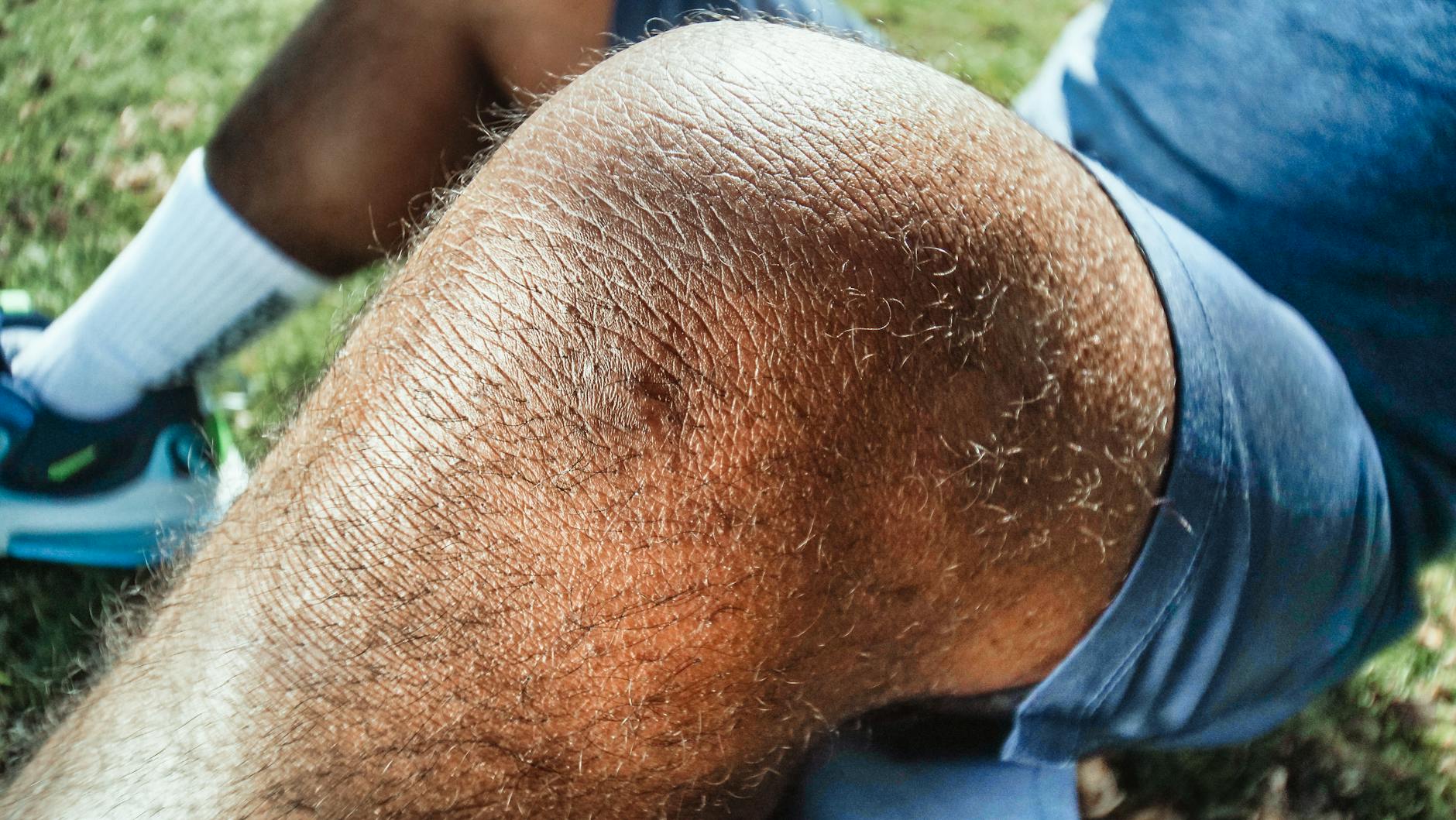
Photo by Kindel Media on Pexels
Your knee starts complaining somewhere around kilometre 6. Maybe it’s a dull ache under the kneecap, or a sharp pinch on the outside of the joint that wasn’t there last week. You slow down, test it, keep going — and by the time you finish, you’re limping slightly and wondering whether you’ve just broken something important. You haven’t. But you do need to understand what’s going on, because “rest and hope” rarely fixes a running knee problem on its own.
Knee pain is the single most common injury complaint among recreational runners. Studies suggest somewhere between 40–50% of all running injuries involve the knee. That doesn’t make it less frustrating, but it does mean there’s a lot of solid information about what causes it and — more usefully — what actually helps. The bad news: most knee issues don’t disappear overnight. The good news: most of them are entirely fixable with the right approach, and you often don’t have to stop running completely to recover.
This article breaks down the four most likely culprits behind your knee pain, how to tell them apart, and what you can do about each one — including how long recovery realistically takes.
The four most common causes of knee pain in runners
Not all knee pain is the same, and treating the wrong problem is one of the most common reasons runners stay injured for longer than they need to. Here’s a quick breakdown of the main suspects:
| Condition | Where it hurts | When it hurts | Common cause |
|---|---|---|---|
| Runner’s knee (PFPS) | Under or around the kneecap | During and after runs, stairs | Weak glutes/quads, overtraining |
| IT band syndrome | Outside of the knee | Usually after 20–30 mins of running | Increased mileage, weak hips |
| Patellar tendinopathy | Below the kneecap (at the tendon) | Start of run, eases then returns | High load, fast training, hard surfaces |
| Pes anserine bursitis | Inside of the knee, slightly below | After runs, sometimes at night | Overuse, tight hamstrings |
If you’re genuinely unsure which one you have — especially if the pain is sharp, sudden, or accompanied by swelling — get it looked at by a physio or sports medicine doctor before you do anything else. Self-diagnosing is fine for narrowing things down, but not for replacing a proper assessment.
Runner’s knee (patellofemoral pain syndrome)
Runner’s knee — formally called patellofemoral pain syndrome (PFPS) — is the most common running-related knee complaint. The pain sits around or behind the kneecap and tends to get worse going downstairs, sitting for long periods with bent knees, or running downhill.
The root cause is usually a tracking problem: your kneecap isn’t moving smoothly in its groove as your leg bends and straightens. This is almost always linked to weakness in the glutes and hip stabilisers, which means the knee is doing more rotational work than it should. It can also be triggered by a sudden increase in weekly mileage — going from 25km to 40km in a fortnight is a classic setup.
What to do: Reduce your mileage by around 30–40% in the short term. Start doing single-leg glute work — clamshells, single-leg deadlifts, lateral band walks — three times a week. Running cadence matters here too: if you’re overstriding (landing heavily with your foot well in front of your body), increasing your cadence by 5–10% can meaningfully reduce kneecap load. Most runners with PFPS see clear improvement in 4–8 weeks with consistent strengthening.
IT band syndrome
IT band syndrome announces itself as a sharp, burning sensation on the outside of your knee, usually appearing at a fairly predictable point in your run — often after 20–30 minutes, or around the 15km mark in longer sessions. It’s caused by friction at the point where the iliotibial band (a thick band of connective tissue running down the outside of your thigh) meets the outside of the knee.
Despite what you’ve probably been told, foam rolling the IT band itself doesn’t fix the problem. The band isn’t a muscle — it doesn’t “loosen.” The real issue is almost always weakness in the hip abductors and glute medius, combined with a sudden increase in training load.
What to do: Back off mileage, and prioritise hip strengthening — side-lying hip abductions, single-leg squats, step-downs. Running on camber (the slope on road edges) can aggravate it, so run on flatter surfaces where possible. Recovery time is honest: mild IT band syndrome might take 3–4 weeks; a properly inflamed case can take 2–3 months. Trying to run through it usually extends the timeline.
Patellar tendinopathy
Patellar tendinopathy means the tendon connecting your kneecap to your shin (the patellar tendon) is overloaded and starting to degrade. The pain sits just below the kneecap. It’s often worse first thing in the morning or at the start of a run, may ease during the middle of a run, and then returns afterwards — that easing-then-returning pattern is a useful diagnostic clue.
It’s common in runners who’ve recently added speedwork, hill reps, or plyometrics, and in those running on hard surfaces with high weekly mileage. According to research on tendinopathy management, the most effective treatment is progressive loading — not rest. Complete rest actually allows the tendon to weaken further.
What to do: Switch to isometric loading initially — wall sits, leg press holds — which reduces pain while maintaining tendon stimulus. Then gradually introduce eccentric and slow heavy loading (decline single-leg squats are the gold standard). Avoid explosive work and steep downhills until pain is consistently below 3/10 during exercise. This one takes patience: 3–6 months for a full-loading programme to work.
How mileage and training errors cause knee pain
It’s worth saying plainly: the majority of running knee injuries are training errors, not structural problems. The most common pattern looks like this — you’ve had a good few weeks, you feel fit, you add an extra long run, jump from 35km to 50km in one week, and two weeks later your knee hurts.
The widely used 10% rule (don’t increase weekly mileage by more than 10% per week) is a blunt tool, but it’s blunt because it’s useful. For someone running 30km/week, that means adding no more than 3km per week. That feels slow. It prevents a lot of knee problems.
Downhill running specifically places roughly 3–4 times your bodyweight through the knee joint per stride. If you’re training for a hilly race and you’ve been hammering the descents in training, that’s worth paying attention to. The NHS guidance on knee pain recommends avoiding activities that worsen symptoms while gradually returning to load — a reasonable starting principle.
Shoes matter too, though perhaps less than the industry suggests. A completely worn-out shoe (check the midsole compression, not just the outsole tread) can alter your mechanics enough to stress the knee. But buying new shoes won’t fix a hip weakness problem.
Should you stop running when your knee hurts?
Not necessarily — but the answer depends on the type and severity of pain. Here’s a rough guide:
- Pain under 3/10 that doesn’t worsen during the run or linger for more than 24 hours afterwards: You can likely continue running at reduced volume and easy effort. Monitor carefully.
- Pain that starts at 2/10 but climbs to 5–6/10 during the run: Stop. Running through escalating pain usually extends injury timelines.
- Pain above 5/10 from the start: Rest from running. Seek assessment.
- Swelling, locking, giving way, or a recent acute injury: See a doctor or physio — these symptoms suggest something beyond standard overuse.
The psychological cost of stopping running is real. If cross-training is an option — pool running, cycling, swimming — it can maintain your aerobic base while you manage load through the knee. Pool running in particular mimics running mechanics well and is almost entirely knee-load-free.
Strength work: what actually helps and when to do it
If there’s one intervention that consistently shows up in the evidence for running-related knee pain, it’s lower body strengthening — specifically the glutes, hip abductors, and quads. Not because you need to become a gym athlete, but because most recreational runners have notable weaknesses in these areas from sitting, desk work, and simply not doing any supplementary training.
Three sessions per week, 20–25 minutes each, is enough to make a real difference within 6–8 weeks. Key exercises to include:
- Single-leg glute bridges — 3 sets of 12 each side
- Lateral band walks — 3 sets of 15 steps each way
- Step-downs (controlled slow descent off a step on one leg) — 3 sets of 10 each side
- Split squats / Bulgarian split squats — 3 sets of 8–10, adding load over time
- Calf raises — 3 sets of 15 (supports overall lower chain mechanics)
The most common mistake is doing this for two weeks, feeling better, and stopping. Tendons and muscles adapt slowly — 8–12 weeks of consistent work is the minimum to build meaningful structural resilience.
The honest takeaway
- Identify the type of knee pain first. Where it hurts, when it hurts, and what makes it worse will point you toward PFPS, IT band, patellar tendinopathy, or something else — and the fix is different for each one.
- Most knee injuries are caused by training errors, not bad knees. A sudden mileage spike, too much downhill, or a jump in intensity is the most common culprit. Fixing the load is part of fixing the knee.
- Strengthen your hips and glutes. This is the most consistent recommendation across every common running knee condition. Three sessions a week for 8–12 weeks is a realistic minimum.
- Running through escalating pain makes most knee injuries worse and longer. A 2-week reduction in training now is better than 10 weeks on the sidelines in a month’s time.
- If it’s been more than 4–6 weeks without improvement despite sensible management, see a physio. Self-managing has limits, and a proper assessment often identifies something (gait, specific weakness, footwear) that’s hard to spot yourself.