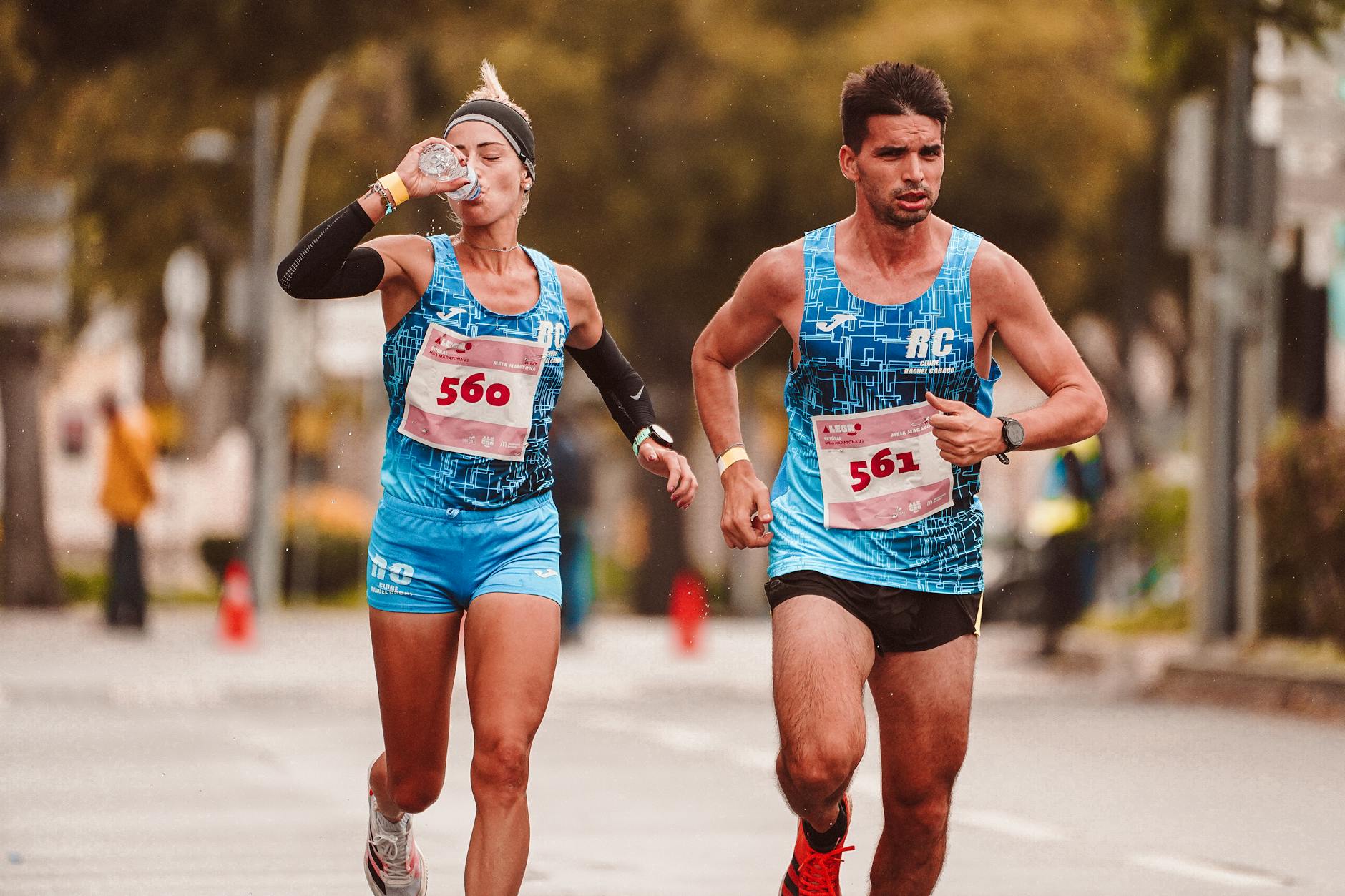
Photo by RUN 4 FFWPU on Pexels
You signed up for a summer race, or maybe you just want to keep your training on track through the warmer months. Either way, you’ve probably already noticed that running in the heat feels harder than the numbers suggest it should. Your easy pace feels like tempo effort. You finish a 5K drenched and deflated. That’s not weakness — that’s physiology doing exactly what it’s supposed to do.
The good news is that running in the heat doesn’t have to wreck your training. But it does require you to adjust — your pace targets, your hydration habits, and your expectations. Ignoring the heat and grinding through your usual paces is one of the most reliable ways to turn a manageable run into a miserable one, or worse, a dangerous one.
This guide gives you the practical numbers and decisions that actually help: when to slow down, how much to drink, what to drink, and how to know when conditions are genuinely too risky to run hard.
Why heat makes running feel so much harder
When your body temperature rises, your cardiovascular system has to work overtime. Blood gets redirected to your skin to help you sweat and cool down — which means less blood is available for your working muscles. Your heart rate climbs faster for the same effort, and your perceived exertion shoots up.
The practical result: your easy pace at 18°C might feel like threshold effort at 28°C. That’s not imagined. Research published by the American College of Sports Medicine confirms that performance can decline by roughly 1–2% for every degree above around 14°C (57°F) in longer events. For everyday runners, that can translate to a minute or more per kilometre feeling completely normal in serious heat.
Humidity makes this worse. If the air is already saturated with moisture, your sweat can’t evaporate efficiently — which is the whole point of sweating. So 25°C with 80% humidity feels significantly harder than 25°C with 30% humidity.
How much to slow down — and a useful rule of thumb
There’s no universal formula, but a sensible working rule for most runners is:
- Above 20°C: Add 15–20 seconds per kilometre to your easy and long run pace
- Above 25°C: Add 30–45 seconds per kilometre, and consider cutting the distance
- Above 30°C with high humidity: Treat the run as effort-based only — ignore pace entirely and run by feel
If you normally run your easy pace at 6:00/km, expect 6:30–6:45/km to feel equivalent in genuine heat. Don’t fight it. Don’t stare at your watch and try to hit your usual splits. The effort — not the number — is what builds fitness.
Here’s a quick reference:
| Temperature | Humidity | Pace adjustment | Notes |
|---|---|---|---|
| Under 20°C | Any | None | Standard training paces apply |
| 20–24°C | Low–moderate | +10–20 sec/km | Minor adjustment, monitor HR |
| 20–24°C | High (70%+) | +20–30 sec/km | Feels significantly harder |
| 25–29°C | Any | +30–45 sec/km | Effort-based running preferred |
| 30°C+ | Any | Run by feel only | Shorten session, prioritise hydration |
| 35°C+ | High | Consider not running | Heat illness risk is real |
Use heart rate as your guide if you have a watch. If your heart rate is 10–15 bpm higher than usual for what should be an easy run, the conditions are affecting you — ease off, don’t push through.
The basics of hydration before your run
Most runners only think about hydration when they’re already thirsty. By that point, you’re likely already mildly dehydrated — and mild dehydration (as little as 2% of body weight) meaningfully reduces performance and makes the heat feel worse.
Start hydrating before you even lace up. Aim to drink 400–600ml of water in the 2 hours before a run in warm conditions. Don’t force it — drinking a litre 10 minutes before heading out mostly just causes discomfort.
A simple check: your urine should be pale yellow before you run. Dark yellow or amber means you’re starting behind.
Hydrating during your run — what actually works
For runs under 30–40 minutes in moderate heat, water alone is usually fine. For longer efforts, or anything above 25°C, you need to think more carefully.
Water: Works well for runs up to about 60 minutes. If you’re sweating heavily, it won’t replace electrolytes, but it’s better than nothing.
Electrolyte drinks or tabs: For runs over 60 minutes in the heat, or if you’re a heavy sweater (you’ll notice white salt marks on your kit), adding sodium is genuinely useful. Sodium helps you retain fluid and replaces what you lose in sweat. NHS guidance on fluid replacement supports this — plain water alone can cause hyponatraemia (low blood sodium) in extreme cases of heavy, prolonged sweating.
How much to drink while running:
A practical guide for most everyday runners in the heat:
- Under 45 min: Sip if available, but skipping is fine
- 45–75 min: 400–600ml total — water is sufficient unless you’re a heavy sweater
- 75 min+: 400–600ml per hour, with electrolytes; drink before you feel thirsty
Don’t rely on thirst alone as your signal during runs over an hour. By the time you feel thirsty in the heat, you’ve already lost enough fluid to affect your performance.
Cooling strategies that actually make a difference
Gear and timing matter more than most runners admit.
Run timing: If you can, shift your run to before 8am or after 7pm in summer. The temperature difference can be 5–8°C compared to midday. That sounds obvious — but it’s also the single biggest lever you have. A 6am run in 18°C is a fundamentally different session from a 1pm run in 28°C.
Light-coloured, technical fabric: Wearing a dark cotton t-shirt in the heat is one of those choices you regret approximately 10 minutes in. Light-coloured, moisture-wicking fabrics make a real difference. A light cap or visor reduces the radiant heat load on your head and face, which helps your overall thermoregulation.
Pre-cooling: If you’re heading into a race or a hard session, holding a cold drink, running cold water over your wrists and neck before you start, or even a cool shower beforehand has been shown in sports science research to improve performance in the heat. It won’t transform your training, but it’s a free marginal gain.
Ice and cold water during the run: Pouring cold water over your head works. It feels dramatic and it genuinely helps — even if temporarily. If there are water stations in your race, use them for cooling, not just drinking.
Knowing when to stop — and when not to start
This is the part most running articles don’t say clearly enough: some conditions are genuinely dangerous, and no training plan is worth heat illness.
Warning signs to take seriously mid-run:
– Dizziness or confusion — stop immediately, find shade, cool down
– Stopping sweating despite feeling very hot — a sign of heat exhaustion moving toward heat stroke
– Nausea or vomiting — your body is telling you something’s wrong
– Heart rate that won’t settle — if your HR is abnormally high for the effort level and won’t come down
Heat stroke is a medical emergency. If you or a running companion collapses, is confused, or stops sweating in severe heat, call emergency services.
A practical rule: if the temperature is above 35°C and humidity is above 60%, seriously consider whether the session is worth running at all. Swap it for an indoor workout, an easy walk, or a rest day. Missing one session matters far less than missing three weeks because you pushed too hard.
Acclimatisation — it does help, and here’s how long it takes
Your body does adapt to running in the heat over time. It takes roughly 10–14 days of regular heat exposure to see meaningful adaptations: improved plasma volume, lower resting heart rate in the heat, and more efficient sweating. This is why runners who’ve been training through a warm spring handle summer better than those who’ve spent May and June on the treadmill.
You can’t fast-track it, but you can start gradually. If heat season is approaching, begin with 20–30 minute easy runs in the warmest part of the day once or twice a week — not your full sessions. Let your body adjust. By week two, conditions that felt brutal in week one will feel manageable.
The Honest Takeaway
- Slow down on purpose. If it’s above 20°C, add 15–30 seconds per kilometre to your easy pace before you even start. Trying to hit summer PBs in July almost always ends badly.
- Hydrate before you’re thirsty. Pale yellow urine before you run, 400–600ml/hour during runs over 60 minutes, and electrolytes if you’re a heavy sweater or going long.
- Timing and shade are your best tools. Run early or late. Use a cap. Pour cold water on yourself without shame.
- Know the red lines. Dizziness, confusion, or stopping sweating in severe heat are not signs to push through. They’re signs to stop.
- Give it two weeks. Heat acclimatisation is real, but it takes consistent exposure. Be patient with yourself in the first hot fortnight of the year — and don’t judge your fitness by those early sessions.