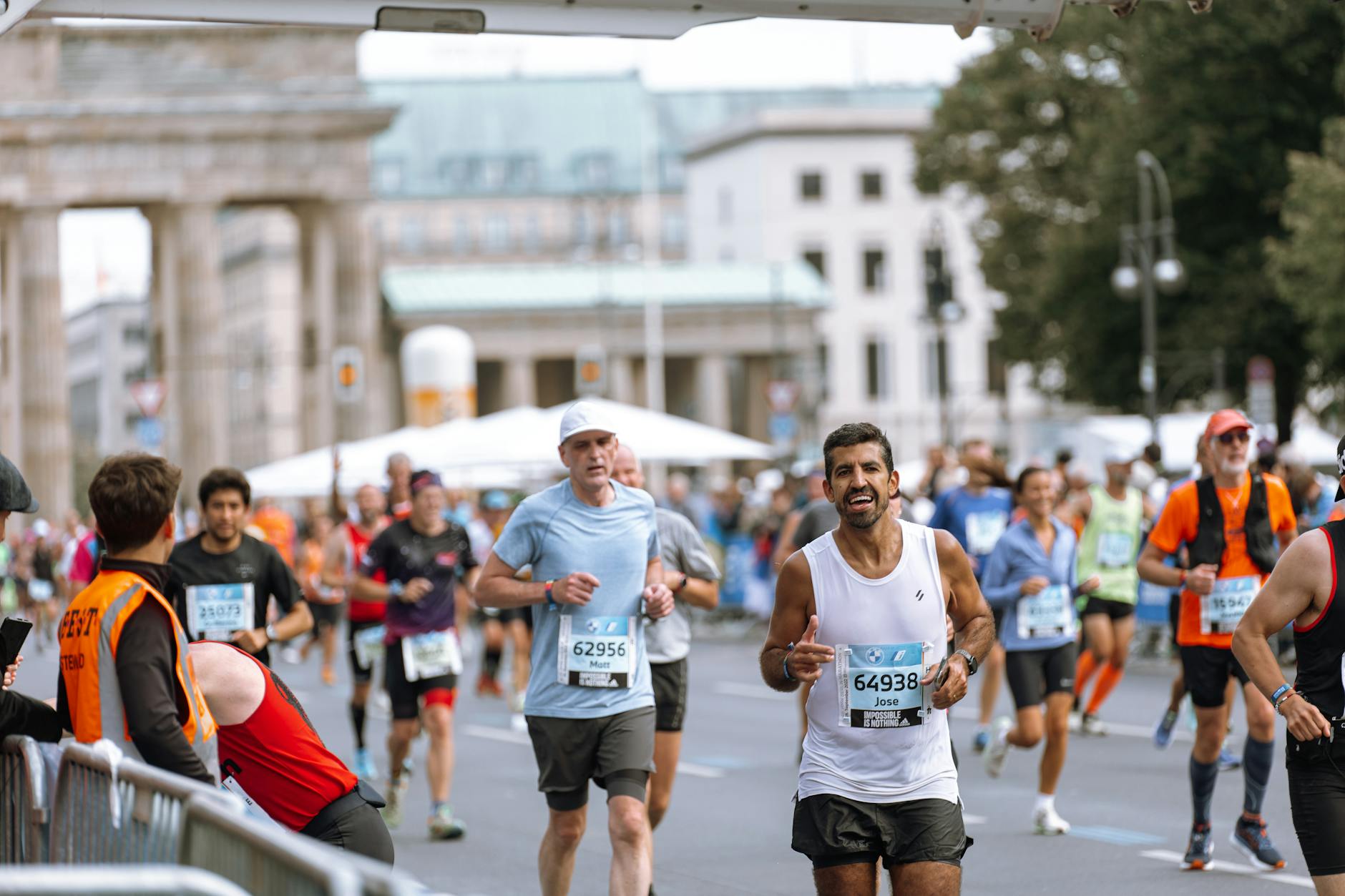
Photo by Eddson Lens on Pexels
How to pick a marathon for your first race
You’ve decided to run a marathon. That’s real — not a vague “someday” idea, but an actual decision. Now comes the part nobody warns you about: choosing the race itself. It’s easy to assume you just Google “marathon near me”, pick one, and sign up. But the race you choose will shape your entire training block, your race-day experience, and — honestly — whether you enjoy the whole thing or swear you’ll never do it again.
There are hundreds of marathons every year across the UK, Europe, and beyond. Some are flat and fast. Some are scenic and brutal. Some have 40,000 runners and a festival atmosphere; others have 400 runners and a bag of crisps at the finish. None of that is inherently good or bad — but it matters enormously for a first-timer. Here’s how to cut through the noise and pick the race that actually suits you.
Give yourself enough time to train properly
This is the first decision, and it’s the one most beginners get wrong. You need a minimum of 16 weeks of structured training to get to the start line feeling prepared — and that’s assuming you can already run 10–15km comfortably before the plan begins. If you’re starting from less than that, 20–24 weeks is more realistic.
So before you fall in love with a race, check the date. Work backwards. If it’s February now and you’ve barely been running, a May marathon is probably too soon. You don’t want to spend your first marathon surviving it because the training was rushed. A September or October race gives you spring and summer to build — which, for most people’s schedules, is far more manageable than training through January dark and cold.
Pick the race date first. Everything else follows from that.
Flat course or “character-building” hills — know what you’re signing up for
Course profile matters. A lot. A flat road marathon and a hilly one are genuinely different events, and finishing times can vary by 15–30 minutes between them for the same runner.
For your first marathon, flat is almost always the right call. You’ll have enough to deal with — pacing, fuelling, managing the wall around miles 18–22 — without adding significant elevation. A course with 300m+ of total elevation gain is a tough ask for a first-timer who hasn’t done specific hill training.
Most race websites publish an elevation profile. Look for it. If you can’t find one, the race’s Strava segment or a quick search on FindMyMarathon will give you the data.
Some races market themselves as “undulating” when they mean “hilly”. Trust the numbers, not the adjectives.
Big city race or small local marathon — what suits you?
This is worth thinking about more carefully than most guides suggest, because the answer isn’t obvious.
| Factor | Large city marathon (5,000–40,000 runners) | Small/local marathon (under 1,000 runners) |
|---|---|---|
| Atmosphere | Electric — crowds, music, signs | Quiet, low-key, can feel lonely |
| Logistics | Bag drops, pacers, water stations | Variable — check specifics |
| Entry cost | £60–£150+ | £25–£60 typically |
| Entry availability | Ballot or sell-out risk | Usually open entry |
| Pacing support | Often has official pace groups | Rarely offered |
| Road closures | Yes — safer | Not always — mixed traffic possible |
| Course accuracy | Certified, chip-timed | Usually, but verify |
If you’re someone who draws energy from crowds and occasion, a bigger city race will carry you through the hard miles. The London Marathon, Manchester Marathon, or Edinburgh Marathon Festival are well-organised, have pacers, and the atmosphere genuinely helps. But they’re harder to get into and more expensive.
Smaller races have real advantages too — less queuing, more accessible, and sometimes more beautiful courses. If you’re someone who prefers head-down running to spectacle, a low-key race is absolutely fine. Just check the logistics carefully: are there enough water stations? Is the course marked clearly? Does it have chip timing?
Check the cut-off time before you commit
Every marathon has a cut-off time — the point at which road closures end and the race officially closes. This varies more than you’d think: some races cut off at 6 hours, others at 7 or 8.
If you’re targeting a finish time of 5:30–6:00 hours, this matters. A race with a 6-hour cut-off leaves zero margin for a tough day, a stomach issue, or a slower-than-expected second half. The Association of International Marathons and Road Races (AIMS) maintains standards for certified courses, but cut-off policies are set by individual race directors.
Don’t assume — email the race organisers and ask. It’s a completely normal question, and any well-run event will have a clear answer.
Weather and time of year: more important than you think
Training through the right season matters, but so does racing in the right conditions. Marathon performance drops significantly in heat — research consistently shows that finishing times slow by 1–2% for every degree above around 10–12°C. Running 42km in 22°C heat as a first-timer is genuinely hard.
Autumn races (September–November) in the UK and northern Europe tend to offer the best conditions: cool, stable, not too dark. Spring races (April–May) are popular but can be unpredictable — you might get perfect 8°C overcast conditions, or you might get an unseasonably warm day.
Summer marathons exist and some people love them, but factor the heat risk honestly. If you’re doing your long runs in 18°C heat and the race is in July, that’s a real consideration — not a reason to avoid it, but something to train and plan around.
Travel and logistics: don’t underestimate the cost to your legs
A destination marathon sounds great, and it can be — but think carefully about what race travel actually involves. Flying the day before a race, sleeping in an unfamiliar bed, walking around a city doing sightseeing the day before, eating unfamiliar food — all of it adds up. For your first marathon, removing unnecessary variables is a legitimate strategy.
A race you can drive to, sleep in your own bed the night before, and eat your normal pre-race meal is a meaningful advantage. Not a dealbreaker if you want an experience, but worth considering. If you’re doing Berlin or Chicago as your first marathon, budget extra time to arrive early and rest properly.
What actually matters on race day: pacers, support, and fuelling
Three practical things to check before you enter:
Pacers: Does the race offer official pace groups? For first-timers aiming for a specific finish time — say, sub-5 hours or sub-5:30 — having a pacer to follow removes a huge amount of mental load. Not all races offer them, and those that do don’t always cover every time target.
Water and gel stations: How frequent are they, and what gels do they provide? If the race provides SiS gels but you’ve trained with Maurten, that’s a problem — you don’t want to try a new gel at mile 18. Most races publish their nutrition partners in advance. Check this, then train with the same product.
Medical support: Larger, established races have this well-covered. For smaller events, it’s worth checking — not to scare yourself, but because it’s a sign of how well-organised the race is overall.
The Honest Takeaway
- Date before destination. Work out how many weeks you have to train, then find races that fit. Don’t choose a race and hope the training works backwards.
- Flat is your friend for race one. Under 150m total elevation is a solid target. Don’t add hills to an already hard day.
- Check the cut-off time explicitly. If you’re targeting 5:30+, a 6-hour cut-off is too tight. A 7-hour cut-off gives you breathing room.
- Match the race atmosphere to who you are. If you need a crowd, get a crowd. If you want something low-key, find one — just verify the logistics.
- Don’t overthink it. The best first marathon is the one you actually sign up for, train for properly, and get to the start line healthy. The rest you figure out on the day.