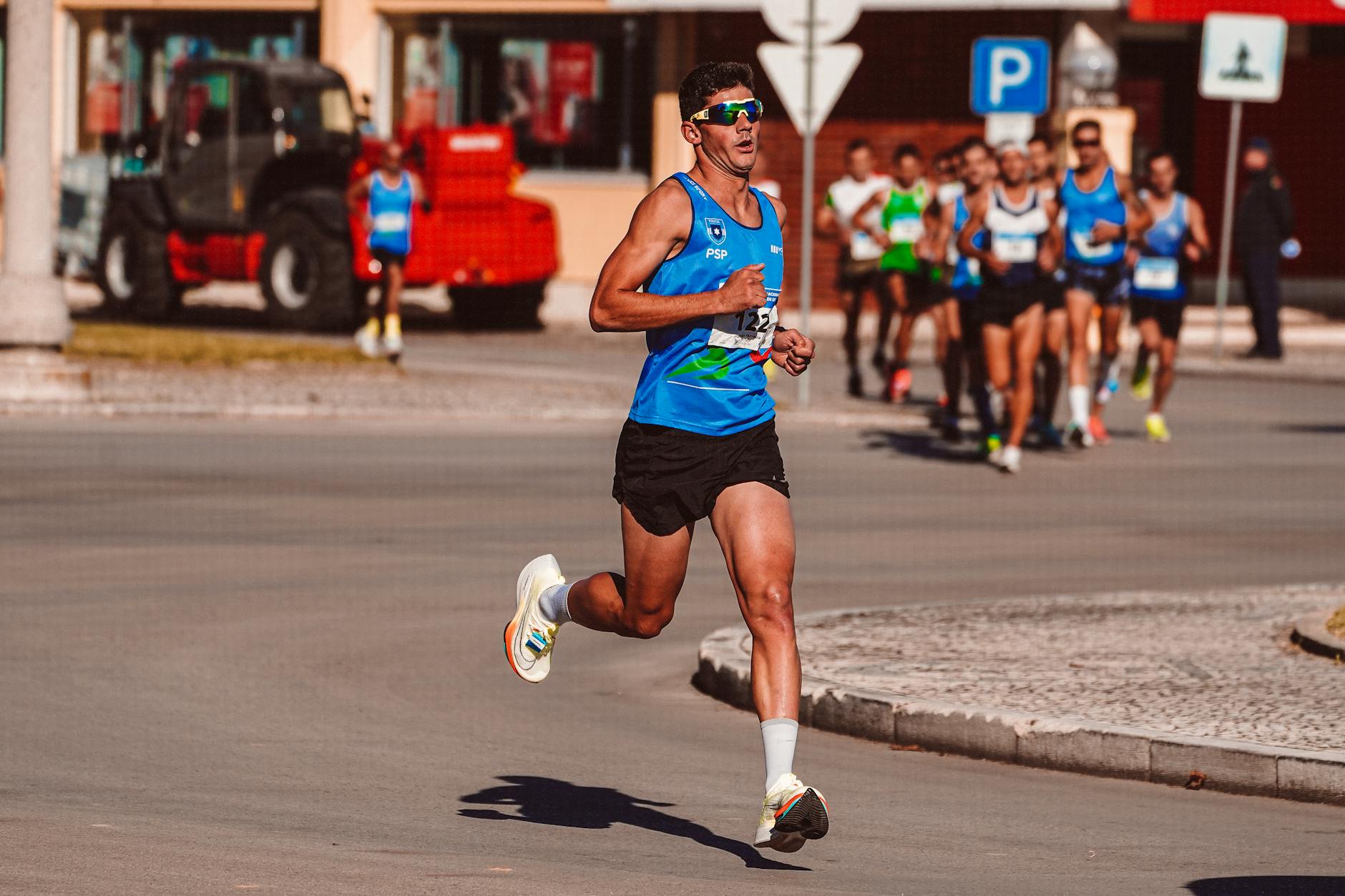
Your first marathon will teach you that pacing is more important than fitness. A runner with decent fitness who paces poorly hits the wall at km 30. A runner with good fitness who paces well finishes strong at km 40.
The difference between 4:30 and 5:30 is almost always a pacing mistake in the first half.
The Fundamental Rule: Negative Split
A negative split means running the second half faster than the first half. It’s counterintuitive—shouldn’t the second half be slower when you’re tired?
In reality, even paced or negative-split marathons feel faster psychologically. You build momentum. You finish with energy. The opposite—running hard early—creates a painful, slow final 10 km.
Data shows:
– Even split: 2:15 first half, 2:15 second half = 4:30 total
– Positive split (bad): 2:10 first half, 2:25 second half = 4:35 total (feels slower, ends in suffering)
– Negative split (good): 2:17 first half, 2:12 second half = 4:29 total (feels faster, ends in relief)
Negative splits don’t mean running hard early, then sprinting later. It means restraint early, pacing discipline middle, and whatever legs you have left at the end.
Your Target Pace and Goal Time
Know your number before race day. If you’re aiming for a 4:30 marathon, that’s 6:24/km (10:18/mile) pace.
| Goal Time | Pace (km) | Pace (mile) |
|---|---|---|
| 4:00 | 5:40 | 9:08 |
| 4:15 | 6:01 | 9:40 |
| 4:30 | 6:24 | 10:18 |
| 5:00 | 7:05 | 11:23 |
| 5:30 | 7:46 | 12:28 |
Print this. Know your splits at each checkpoint:
– 5K: roughly 28–30 min (depending on pace)
– 10K: roughly 57–60 min
– Half-way (21.1K): roughly 2:05–2:15
– 30K: roughly 3:02–3:14
– 40K: roughly 4:34–4:45
Write your pace goal on your bib or wrist tape. Look at it regularly.
The Three Phases of Marathon Pacing
Phase 1: Km 0–15 (The Adrenaline Zone)
You feel fresh. Your legs are bouncy. The crowd is loud. You want to run fast.
Don’t.
Target pace here: 5–10 seconds per km SLOWER than goal pace.
If you’re aiming for 6:24/km (10:18/mile), run 6:30–6:35/km (10:28–10:36/mile) here.
Why? Because the first 15K aren’t representative of how your body will feel at km 25. You’re using fresh glycogen and adrenaline. By km 25, you’ll be living off fuel and willpower.
At km 15, you want to think: “That felt easy. I barely did anything. I’m in control.” If you think “That was a good effort,” you went too fast.
Phase 2: Km 15–30 (The Work Zone)
This is where the race actually starts. Your fuel is being depleted. Your legs are no longer fresh.
Target pace here: goal pace, steady.
Km 15–21.1 (half-way): hit your exact goal pace. This is your flyby point. If you see your half-way split and it’s faster than target, you’re on borrowed time.
Half-way target for a 4:30 marathon: 2:09–2:12 elapsed time.
If you see 2:07, you went out too fast. You’ll pay for it in Phase 3.
Km 21.1–30: maintain goal pace despite fatigue setting in. This is mental. Your legs are heavier. The miles are getting long. Distract yourself. Eat, drink, focus on form. Miles 13–19 (km 21–30) are often the slowest in this phase, a 10–15 second/km slowdown is normal.
Phase 3: Km 30–42.2 (The Survival Zone)
This is not “running.” This is managing the damage. You have 12 km left and your legs don’t have much left.
Target pace here: whatever you can maintain, ideally goal pace but realistic drop of 15–30 sec/km.
Your goal is not to speed up. Your goal is not to blow up (stop or slow to a walk for extended periods).
If you ran Phase 1 and 2 correctly (conservatively in Phase 1, steady in Phase 2), you’ll have legs here. You might run 6:30–6:45/km (10:28–10:50/mile) instead of 6:24/km, but you’ll keep moving.
If you ran Phase 1 too fast, you’re now at 7:30+ /km (12:00+/mile) and struggling mentally.
The difference is 30 seconds per km. Over 12 km, that’s 6 minutes. Small pacing mistakes compound.
The Splits and Checkpoint Strategy
Write down target splits at major checkpoints. This gives you a real-time pacing guide.
For a 4:30 marathon (6:24/km / 10:18/mile):
– 5K: 32 min
– 10K: 64 min
– 15K: 96 min (1:36)
– Half-way (21.1K): 2:08–2:11
– 30K: 3:12
– 35K: 3:44
– 40K: 4:16
– Finish (42.2K): 4:30
Every 5K checkpoint, check your watch. If you’re ahead, slow down. If you’re behind, reassess (but don’t try to “catch up” hard—adjust gradually).
Nutrition and Hydration: The Pacing Multiplier
You cannot maintain pace without fuel. A pacing plan without a nutrition plan is fiction.
- Drink 500–750 mL per hour (water + electrolytes). Dehydration slows you down 30–60 seconds per km.
- Consume 30–60g carbs per hour (gels, sports drink, energy bars). Running on empty at km 25 feels like running in quicksand.
- Start hydrating and fueling early (km 5), not at km 20 when you’re desperate.
A single skipped hydration station can add 2–3 minutes to your final time.
Mental Tactics for Pacing Discipline
Pacing discipline is harder than fitness. Your body wants to race. Your mind wants to compete with the person next to you.
-
Break the race into thirds: 0–14K, 14–28K, 28–42K. The race is three races, not one long slog.
-
Focus on the next km, not the total distance. At km 20, don’t think “I have 22K left.” Think “I’ll nail the next 3K.”
-
Have a mantra: “Patient and strong,” “pace discipline,” “trust the plan.” Repeat it when tempted to speed up.
-
Know who you’re racing: For your first marathon, you’re racing your watch, not the person next to you. They might blow up at km 30. You won’t.
-
Use aid stations as reset points: Every aid station, drink, eat, reset your focus. Mentally, the race is a series of 5K segments between stations, not one 42K slog.
Common Pacing Mistakes
-
Running with the pack in Phase 1 — the pack is almost always running too fast. Let them go. You’ll see them at km 25 walking.
-
Trying to make up time in Phase 2 — if you’re behind at km 15, you already made a mistake. Don’t compound it. Accept your pace and finish strong.
-
Skipping aid stations — “I’ll just have a sip” turns into dehydration. Use every station.
-
No practice pacing — run a half-marathon at goal pace before the full marathon. Know what goal pace feels like at km 15, km 20.
-
Ignoring splits — if you don’t check your watch at checkpoints, you won’t know you’re too fast until it’s too late.
How to Practice Pacing in Training
Your long runs are pacing practice. Do this once before race day:
- Run a 30K long run with 10K in the middle at marathon goal pace. The first 10K should feel easy, the goal-pace 10K should feel controlled, the final 10K should be steady.
- Check your splits every 5K. This teaches you what goal pace feels like.
- Practice your race-day nutrition on this run. Gels, drink, all of it.
The Honest Takeaway
Pacing is the difference between a good marathon and a nightmare. Control the first 15K, maintain discipline in the middle 15K, and survive (or thrive) in the final 12K.
- Run km 0–15 at 5–10 sec/km slower than goal pace — let the fast starters blow up.
- Run km 15–30 at exact goal pace — this is your real race.
- Run km 30–42.2 at whatever pace you can sustain — if you paced right, you’ll have something left.
- Know your splits and check them every 5K.
- Fuel and hydrate consistently — pacing discipline fails without nutrition.
The runners who finish marathons strong didn’t run faster than the ones who suffered. They ran smarter.
Sources:
– Journal of Sports Medicine: Pacing Strategy and Marathon Performance
– Runner’s World: Marathon Pacing and Fueling Strategy