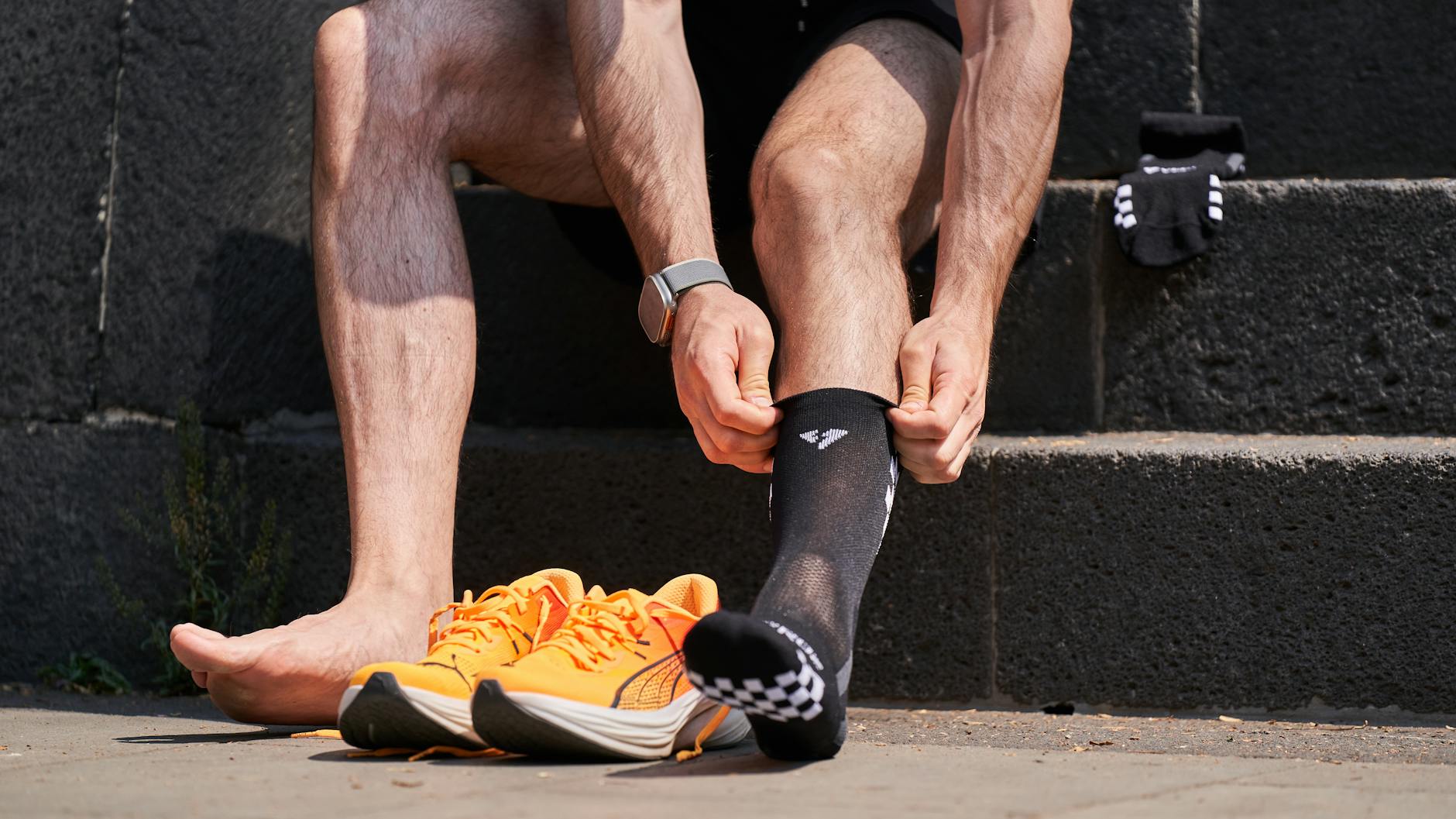
Photo by Willians Huerta on Pexels
Compression socks for running: do they actually work?
You’ve seen them at every race start line — those knee-high, aggressively coloured tubes of fabric that make runners look like they’re dressed for a ski trip. Compression socks have been a staple of running culture for years, with claims ranging from improved performance to faster recovery to reduced injury risk. But if you’ve ever wondered whether they’re worth £30–£50 a pair or just an expensive placebo, you’re not alone.
The honest answer is: it depends on what you’re expecting them to do. The research is real but mixed, and the benefits are more specific than the marketing suggests. This article breaks down what compression socks actually do, what they don’t do, and when wearing them might genuinely make a difference for you.
What compression socks actually do (the basic physiology)
Compression socks apply graduated pressure to your lower leg — typically tightest at the ankle (around 15–20 mmHg for most running-grade socks) and gradually looser as they move up toward the knee. This is the same basic principle used in medical compression stockings for people with circulation issues.
The theory is that by compressing the veins and soft tissue, the socks help push deoxygenated blood back up toward the heart more efficiently, reduce muscle oscillation (the vibration and micro-movement of muscles during impact), and support the calf and lower leg generally. Whether those mechanisms translate into meaningful running benefits is where things get more complicated.
What the research actually says about performance
Let’s start with the most appealing claim: that compression socks make you run faster. The evidence here is thin. Most controlled studies have found little to no improvement in VO2 max, running economy, or race times when runners wear compression socks during a run.
A review of compression garment research published in the British Journal of Sports Medicine found that the evidence for performance benefits during exercise was weak and inconsistent across studies. The effect sizes were small, and many studies were methodologically flawed — small sample sizes, self-reported outcomes, no blinding.
That said, a few studies have found modest benefits in specific conditions — longer efforts (marathons and ultras), hot weather, and in runners who already have venous insufficiency or circulation issues. If you’re running a 4-hour marathon in warm conditions, there may be something in it. If you’re doing a 25-minute parkrun, probably not.
Where compression socks do seem to earn their place: recovery
This is the area where the evidence is more convincing. Wearing compression socks after a hard run — for several hours, or overnight — does appear to help with recovery in a meaningful way.
Studies have shown reductions in delayed onset muscle soreness (DOMS), faster return to normal muscle function, and reduced perceived fatigue in the 24–48 hours after hard efforts when compression is worn post-run. Research published in the Journal of Strength and Conditioning Research found that compression garments worn after eccentric exercise — the kind of muscle loading that happens going downhill — significantly reduced soreness and strength loss.
For most everyday runners, this is the most practical use case. If you’ve done a long run on Sunday morning and you want to feel less wrecked on Monday, slipping on a pair of compression socks after your shower and wearing them for the rest of the day is a reasonable, evidence-nudged strategy. It’s not magic. But it’s not nothing either.
A quick breakdown: when compression socks are likely to help (and when they’re not)
| Situation | Likely benefit | Verdict |
|---|---|---|
| During a 5K or parkrun | Minimal evidence | Skip them |
| During a marathon or ultra | Possibly modest benefit for fatigue | Worth trying |
| Post-run recovery (worn after, not during) | Reasonably well supported | Yes, if you suffer from DOMS |
| Long-haul travel after a race | Good circulation evidence | Yes — solid use case |
| Injury prevention (shin splints, calf strains) | Limited evidence, anecdotal support | Maybe, worth trialling |
| During easy or recovery runs | No meaningful evidence | Personal preference |
| If you have varicose veins or poor circulation | Strong medical evidence | Definitely — see a GP |
The injury prevention question
This one gets trickier. A lot of runners buy compression socks specifically because they’ve had shin splints, calf tightness, or Achilles issues, and someone at the running shop recommended them. The honest answer is that the research on injury prevention is sparse and mostly inconclusive.
There’s some evidence that reducing muscle oscillation — that vibration and micro-movement during ground contact — might reduce cumulative muscle damage over long runs. And anecdotally, many runners with chronic calf tightness swear by them. But if you’re using compression socks as a substitute for actually addressing a recurring injury, you’ll be disappointed. They’re not a fix. They might be a small part of a management strategy, alongside strength work, load management, and physio input where needed.
If you’re regularly dealing with lower leg issues, the more useful questions are: how’s your weekly mileage progression? Are you doing any calf strengthening? Is your footwear appropriate for your gait? Compression socks sit somewhere down the list of levers worth pulling.
How to choose and wear them properly
If you’re going to try compression socks, fit matters more than brand. Here’s what to look for:
- Compression level: 15–20 mmHg is typical for running. Medical-grade is 20–30 mmHg and above — you don’t need that unless a clinician recommends it.
- Length: For running, knee-high (calf sleeves count here too) is the standard. Ankle-only compression socks don’t offer the graduated pressure that matters.
- Fit: They should feel snug but not painfully tight. If your toes are going numb or the top band is leaving deep marks, they’re too tight.
- Fabric: Moisture-wicking materials matter if you’re wearing them during a run. For recovery use only, it matters less.
- Try a calf sleeve instead: If you find full socks uncomfortable during runs, graduated compression calf sleeves give you the same lower-leg compression without the full-foot commitment.
Some runners find compression socks uncomfortable during runs — too warm, too constricting, or just a faff to get on with sweaty legs. If that’s you, using them purely as a recovery tool (post-run, on the sofa, overnight) gets around the issue entirely.
What about flying after a race?
This is probably the clearest, least contested use case. Long-haul flights after a marathon or big race event combine dehydration, immobility, and legs that are already inflamed — exactly the conditions where compression socks do their thing. The evidence for compression in reducing DVT risk during long flights is solid enough that it’s a mainstream medical recommendation. If you’re flying home after a destination race, pack them.
The honest takeaway
- Don’t expect them to make you faster. The performance-during-running evidence is weak. If you’re chasing a sub-2 hour half marathon, the time is better spent on your training structure.
- Recovery use is the strongest argument. Wearing compression socks for 3–6 hours after a long run or race does seem to reduce DOMS and help your legs recover faster. That’s a genuinely useful tool, especially if you’re running on tired legs mid-week.
- Fit is everything. Wrong-sized compression socks can impede circulation rather than help it. Measure properly and don’t guess.
- They’re worth trialling if you have chronic lower-leg fatigue. Not as a cure, but as a low-risk addition to a sensible recovery routine. Give it 4–6 weeks of consistent post-run use before deciding.
- Post-flight use is an easy yes. Especially if you’re racing abroad and flying home with heavy legs. No downside, reasonable upside.