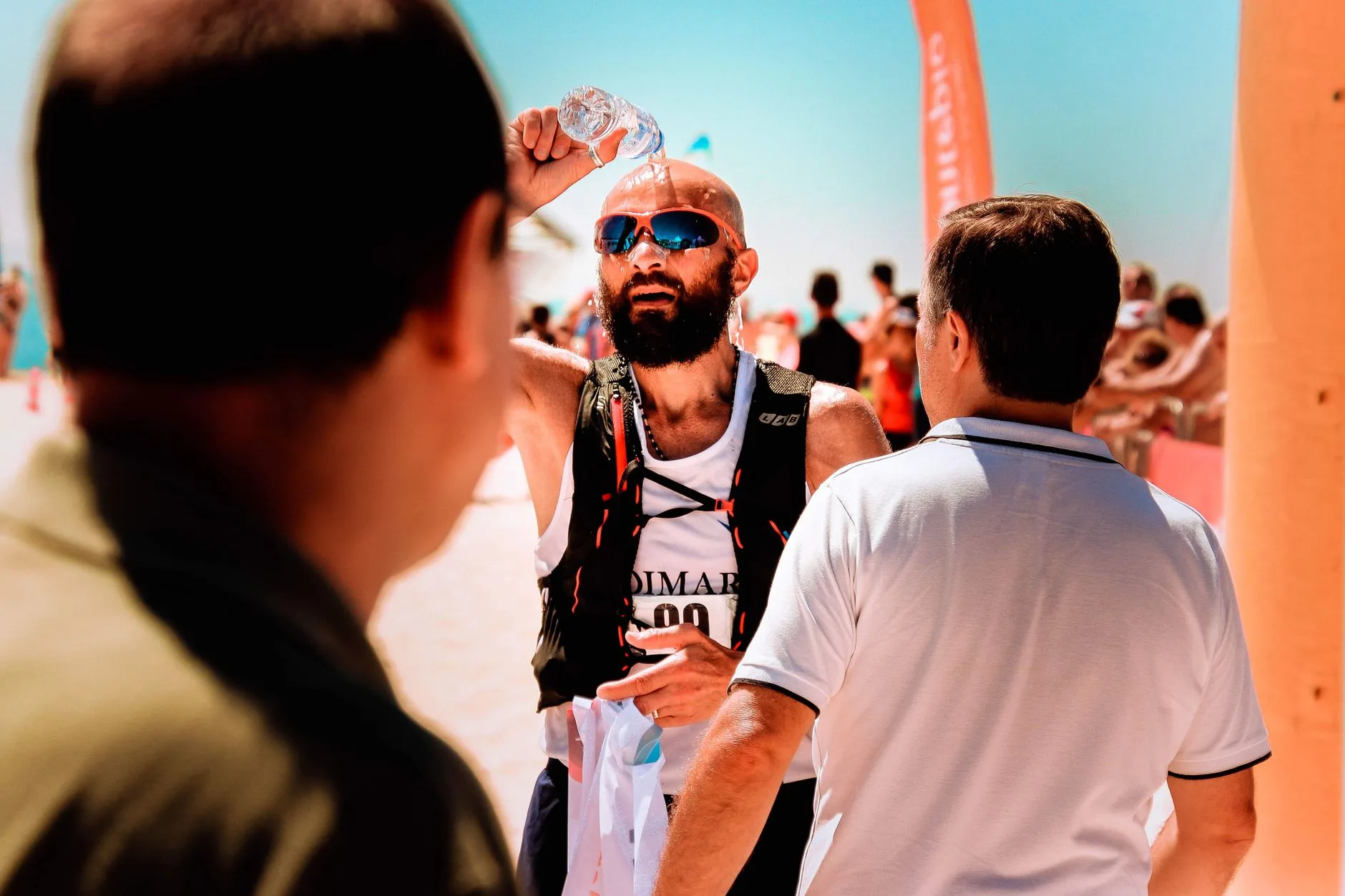
Photo by RUN 4 FFWPU on Pexels
Running in the heat is harder than running in cool conditions — measurably so. At 25°C, the same pace requires approximately 5% more effort than at 10°C. At 30°C, the difference is larger. Understanding why, and adjusting accordingly, allows you to keep running safely and effectively through summer.
Why Heat Makes Running Harder
When you run in the heat, your body faces two competing demands:
- Delivering oxygen to working muscles (the normal demand of running)
- Dissipating heat from the body’s core (the additional demand of hot conditions)
To manage heat, the body diverts blood flow toward the skin (for cooling) and away from the muscles. This means less oxygen delivery to muscles at the same effort. The heart rate rises to compensate, working harder to maintain output.
Additionally, sweating increases fluid loss. As dehydration progresses (even at 2% of body weight), plasma volume decreases, making it harder for the heart to maintain cardiac output — and performance declines further.
The practical result: the same pace in 30°C heat will produce a heart rate 10–20+ beats per minute higher than in 15°C. Running at your usual effort in the heat means accepting a slower pace.
Adjusting Your Training for Heat
Run by effort, not pace: On hot days, run at the same perceived effort as normal, not the same pace. Expecting to hit your usual splits in 30°C is setting yourself up for overheating and disappointment.
Use heart rate: If you train with heart rate, keep easy runs in the same heart rate zone as usual — which will mean a slower pace in heat. This is the correct approach.
Adjust session type: Move interval and tempo sessions to cooler times of day (early morning, evening) rather than skipping them. Save long easy runs for the morning. In extreme heat, replace outdoor hard sessions with indoor alternatives (treadmill in air conditioning) or reduce intensity.
Shorten sessions initially: The first few weeks of hot weather are the hardest. The body hasn’t yet heat-adapted. Shorter, easier sessions at the start of a hot spell are sensible.
Timing Your Runs
Early morning: The coolest time of day in most locations — temperatures are typically 5–10°C lower than the afternoon peak. This is the recommended time for most training in hot conditions.
Evening: Also substantially cooler than afternoon, though roads and pavements retain heat from the day. Still significantly better than midday.
Avoid 10am–4pm in high summer — this is when solar radiation and ambient temperature are both at their peak. Running in direct midday sun adds significant heat load beyond the ambient temperature.
Hydration
Before: Start well-hydrated. Urine should be pale yellow before a hot weather run. Dark yellow urine indicates dehydration going in.
During: Drink approximately 400–800ml per hour in hot conditions, adjusted for your sweat rate. Sports drinks or water with electrolytes (sodium in particular) are better than plain water for runs over 45–60 minutes, as they replace the sodium lost in sweat.
Don’t over-drink: Hyponatraemia (dangerously low sodium from excess water intake) is a real risk during long hot-weather runs. If you’re drinking large quantities of plain water and feeling woozy or nauseous, this may be the cause. Electrolytes and moderating water intake are the solution.
After: Replace approximately 1.5× the fluid you lost (weigh yourself before and after to estimate — 1kg of weight loss = approximately 1 litre of fluid lost).
Clothing and Gear
Light-coloured, moisture-wicking fabrics: Light colours reflect solar radiation; synthetic moisture-wicking fabrics move sweat away from the skin more effectively than cotton.
Loose-fitting: Better air circulation than fitted clothing in high heat (fitted compression clothing is better for cold weather).
Hat and sunglasses: A light hat with a brim reduces direct solar heat load on the head significantly. Sunglasses protect against UV and reduce squinting-related muscle fatigue.
SPF: Apply sunscreen on any exposed skin for runs over 30 minutes in direct sunlight.
Cooling vest: Used by serious athletes for pre-cooling before races in heat — not a training essential, but genuinely effective for events.
Heat Acclimatisation
The body adapts to running in heat over approximately 10–14 days of regular exposure. These adaptations include:
- Increased plasma volume (more blood)
- Earlier onset of sweating (more effective cooling)
- Lower core temperature at the same exercise intensity
- Lower heart rate at the same effort
If you have a summer race, plan to do your easy runs outside in the heat 10–14 days before the event to acclimatise. Running in cool air conditioning for all training then racing in 28°C means you haven’t acclimatised at all.
Warning Signs to Stop Immediately
Heat exhaustion: Heavy sweating, weakness, cold/pale/clammy skin, fast or weak pulse, nausea, muscle cramps, fainting. Stop running, move to shade, drink cool water, apply cool water to skin. Seek medical help if symptoms are severe.
Heat stroke: High body temperature (above 40°C), hot/red/dry skin (sweating may stop), rapid and strong pulse, unconsciousness. This is a medical emergency — call 999 immediately.
Know the difference: heat exhaustion is manageable; heat stroke is life-threatening.
Summary
Running in heat requires adjusting your expectations and approach:
- Slow down — run at effort, not pace; the same perceived effort will produce a slower pace in heat
- Run early morning — temperatures can be 8–10°C lower than the midday peak
- Stay hydrated — but use electrolytes for runs over an hour rather than plain water alone
- Start sessions shorter at the beginning of a hot spell — heat acclimatisation takes 10–14 days
- Know the warning signs of heat exhaustion and heat stroke — stop if symptoms develop
Next read: How to run in bad weather: race day tips for wind, rain, cold