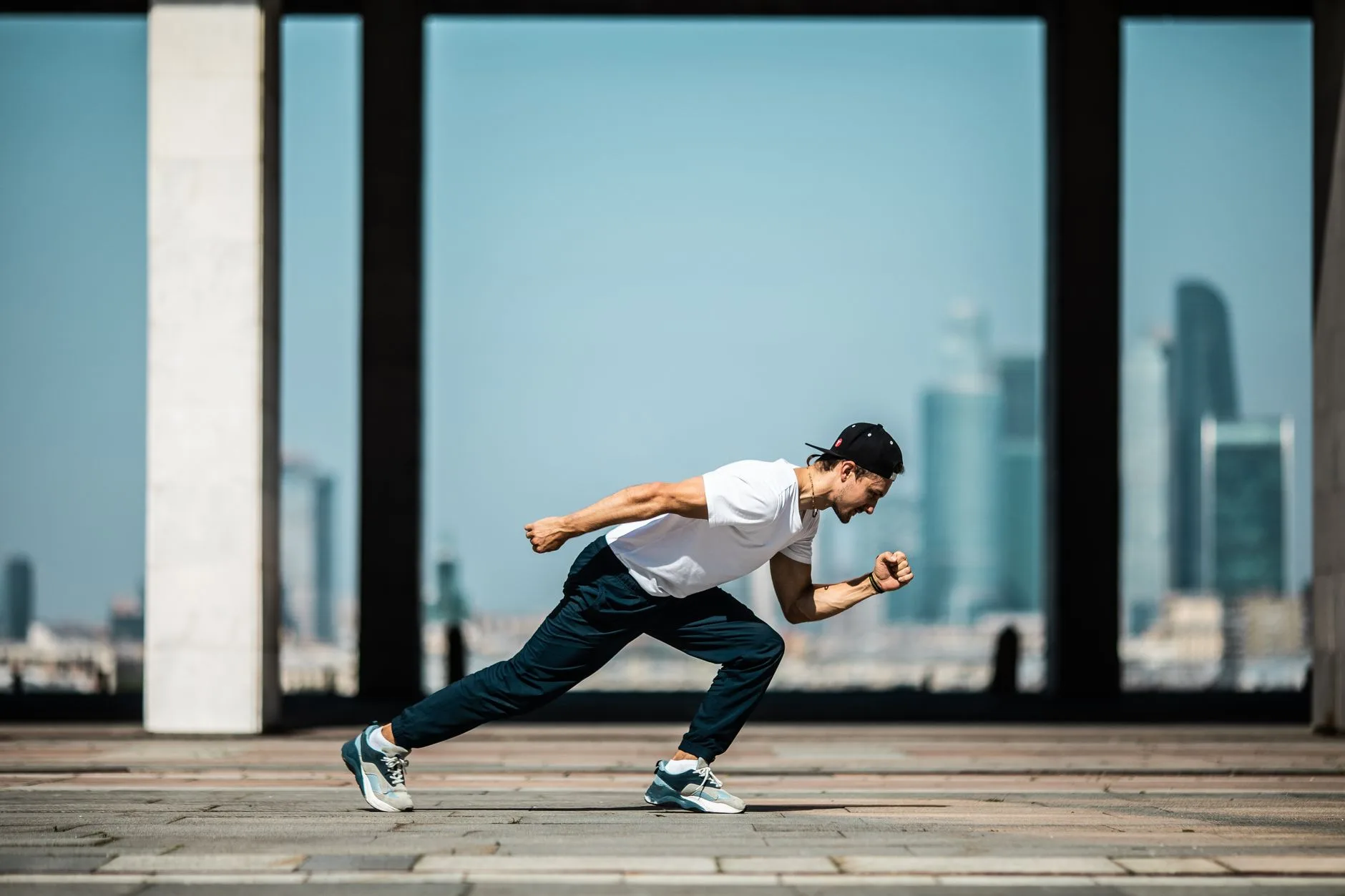
Photo by Niko Twisty on Pexels
Running cadence — also called stride rate — is the number of steps you take per minute when running. It’s one of the most commonly discussed metrics in running, frequently cited alongside the oft-quoted “180 steps per minute” target. Understanding what cadence actually means and whether it’s worth changing requires unpicking a number of misconceptions.
What Is Running Cadence?
Cadence (or stride rate) is measured in steps per minute (SPM). Some sources quote it as strides per minute — a stride being two steps (right foot plus left foot) — which halves the number to approximately 85–95 SPM.
For this guide, cadence = steps per minute (both feet combined).
Typical cadence ranges:
– Beginner runners: 150–165 SPM
– Recreational runners: 165–175 SPM
– Experienced recreational runners: 170–180 SPM
– Elite runners: 180–200 SPM
The 180 SPM Target
The 180 steps per minute figure comes from Jack Daniels (the running coach, not the whiskey), who observed that elite distance runners at the 1984 Olympics all ran at or above 180 SPM regardless of pace. The figure was widely adopted as a target for recreational runners.
The problem: elite runners run much faster than most recreational runners, and faster running naturally produces a higher cadence. The 180 figure reflected elite race pace, not optimal cadence for all speeds.
More recent research suggests that optimal cadence is individual and pace-dependent. At a slow easy pace (say, 10 minutes per mile), 160–165 SPM may be perfectly efficient. At race pace, the same runner might naturally hit 175–185 SPM. There’s no universal target that applies across all speeds and body types.
Why Cadence Matters
Overstriding and impact: The main reason cadence is discussed is because low cadence (below 160 SPM) is often associated with overstriding — landing with your foot significantly in front of your centre of mass. Overstriding increases braking force with each footstrike, creates higher impact loading on joints, and is linked to injury risk (particularly shin splints, knee pain, and stress fractures).
Increasing cadence by 5–10% naturally shortens stride length, which tends to bring the footstrike closer to the body, reducing braking forces and impact load.
Running economy: Higher cadence (at equivalent pace) typically means shorter, quicker steps — which reduces ground contact time and can improve running economy. But this relationship is complex and individual.
How to Measure Your Cadence
Most GPS watches (Garmin, Polar, Apple Watch with running metrics) measure cadence automatically. Check your running app after a run.
Manual counting: Count the number of times your right foot hits the ground in 30 seconds, then multiply by 4 (to get both feet, per minute). Do this during a comfortable easy run, not a fast effort.
Should You Change Your Cadence?
Not necessarily. Cadence is only worth actively changing if:
- You’re experiencing overstriding-related injuries (shin splints, knee pain) and your cadence is below 160 SPM
- Your cadence is significantly lower than what would be expected at your training pace
- You’ve been assessed (by a physio, coach, or running gait specialist) and overstriding has been identified as a contributing factor to injury
If your cadence is 165–175 SPM and you’re running injury-free, there’s no strong reason to change it.
How to Increase Cadence
If you decide cadence improvement is warranted, the most effective approaches:
Metronome training: Use a running metronome app (set to your target SPM) and consciously match your steps to the beat. Start with 5–10% above your current cadence on easy runs for short sections (10 minutes per run). Over several weeks, the higher cadence becomes more natural.
Shorter steps, not faster feet: The cue “shorter, quicker” is more effective than “run faster.” Think of reducing stride length rather than pumping your arms faster.
Uphill running: Running uphill naturally shortens stride length and increases cadence — regular hill work can improve cadence without conscious effort.
10% rule: Don’t increase cadence by more than 10% at a time — changes to movement patterns take weeks to adapt to and too-rapid changes can cause overuse injuries in different muscles.
Cadence and Pace
Cadence naturally increases as pace increases. Your easy run cadence will be lower than your 5K pace cadence, which will be lower than your sprint cadence. This is normal — don’t try to maintain race-pace cadence during easy runs.
Summary
Running cadence is a useful metric — but the 180 SPM target is not a universal prescription:
- Measure your current cadence before deciding whether to change it
- If you’re injury-free, don’t chase 180 SPM — your natural cadence at each pace is likely appropriate
- If you overstride and have related injuries, increasing cadence by 5–10% reduces impact loading and braking forces
- Use a metronome app for cadence training — consciously matching a beat is more effective than trying to “run faster”
- Cadence increases naturally with pace — your easy run cadence will always be lower than your race cadence
Next read: Running economy: what it is and how to improve it