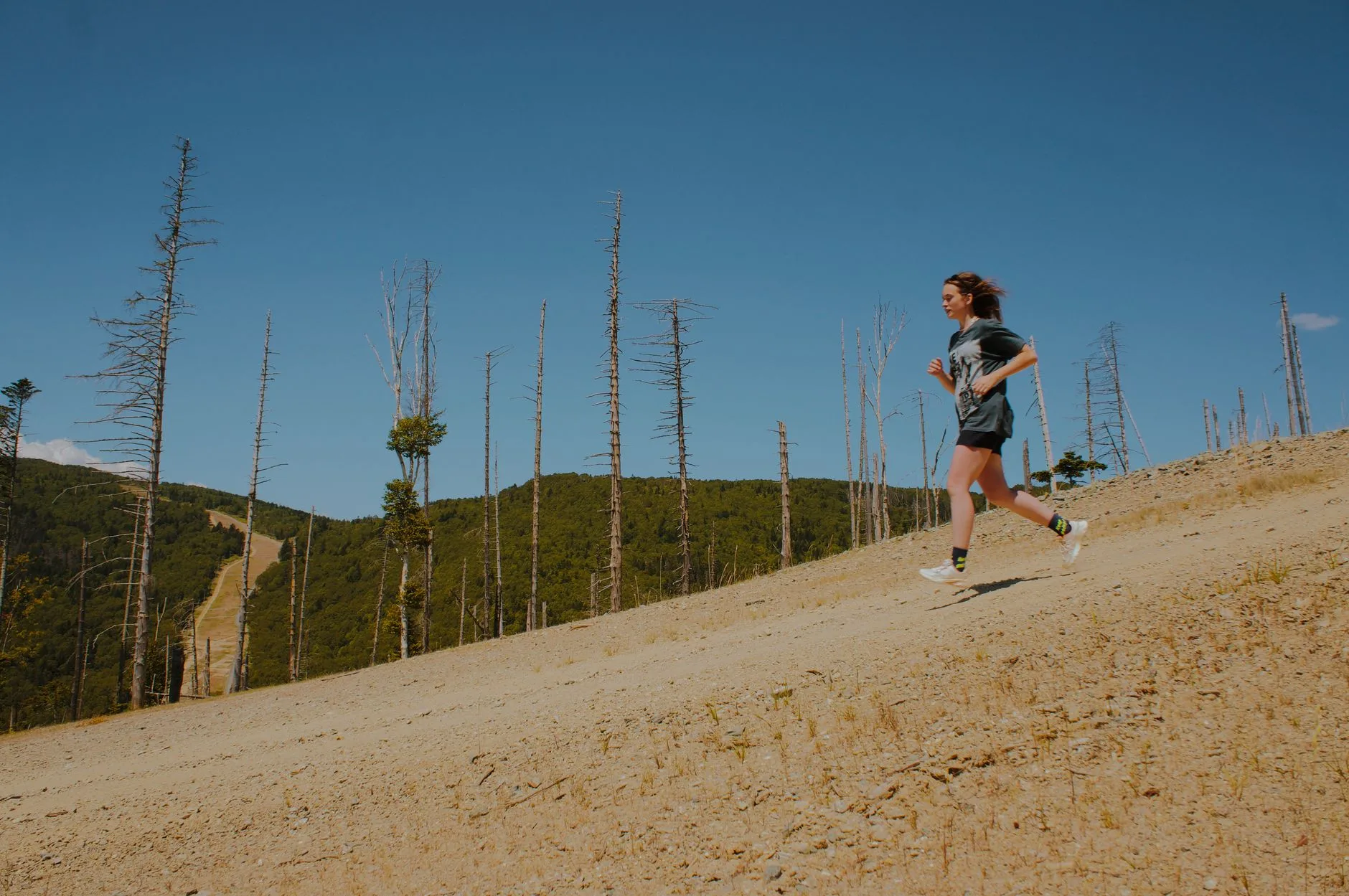
Photo by Gleb Dolskiy on Pexels
You don’t need a track, a fancy gym or a structured speed programme to start running faster. You just need a hill — and the willingness to run up it repeatedly until it stops feeling terrible (which it will, eventually).
Hill training is one of the most underused tools in the everyday runner’s kit. It’s not glamorous. It’s not complicated. But done consistently, it builds leg strength, improves your running economy, and makes flat running feel noticeably easier. That last point alone is worth taking seriously.
This article covers why hills work, what they actually do to your body, and — most importantly — how to structure sessions that fit around a normal training week. You don’t need to run five days a week for this to be useful. Even one hill session per week, built in consistently over six to eight weeks, will make a difference you can feel.
Why hills work: the physiology in plain English
When you run uphill, your body has to work harder to move forward. That sounds obvious, but the consequences are worth unpacking. You recruit more muscle — particularly your glutes, hamstrings and calves — than you would on flat ground. You drive your knees higher. You lean forward from the ankles. Without realising it, you’re drilling better running mechanics.
The effort of running uphill also forces your heart rate up quickly, which gives you cardiovascular stimulus without the pounding impact of flat sprints. Because your stride length shortens on a climb, the forces going through your legs per step are actually lower than during flat-speed work. That makes hills a lower-injury-risk way to train hard — a genuine rarity.
Research published in the Journal of Strength and Conditioning Research has shown that hill training improves running economy — essentially, how efficiently you use oxygen at a given pace. Better running economy means you go faster for the same effort. For an everyday runner, that’s the difference between grinding out a 10K and running it with something left in the tank.
What hill training actually improves
Let’s be specific about what you’re developing:
- Leg strength — particularly posterior chain (glutes, hamstrings, calves). Weak glutes are behind a lot of common running injuries. Hills strengthen them without weights.
- Running form — the uphill position (slight forward lean, high knees, short stride) mirrors good flat-ground mechanics. You’re correcting form by accident.
- VO2 max — short, hard hill reps push your cardiovascular system in a way that steady running doesn’t. Over weeks, your aerobic ceiling rises.
- Mental toughness — there’s nothing ambiguous about a hill. You either run up it or you don’t. That clarity is useful for race day.
- Flat-ground pace — after a block of hill training, many runners find their easy pace improves without any other changes. The strength carries over.
If you’re building towards a half marathon or marathon and you’re currently doing all your runs on flat roads, adding hills is one of the quickest ways to improve. If you’re following something like the 16-week marathon training plan for beginners, slotting one hill session into your midweek run from week four onwards can add a useful training stimulus without blowing up your recovery.
How steep and how long: finding the right hill
You don’t need a mountain. In fact, very steep hills (more than 10–12% gradient) can cause problems — they shorten your stride too much and put stress on your Achilles. A gradient of 4–8% is ideal for most sessions. Think a steady incline you can run up hard for 30–90 seconds, not something that makes you grab fences.
Hill length matters too:
| Session type | Hill gradient | Rep length | What it trains |
|---|---|---|---|
| Short hill sprints | 6–10% | 8–12 seconds | Speed, power, neuromuscular strength |
| Hill reps (classic) | 4–6% | 45–90 seconds | Strength-endurance, VO2 max |
| Long hill repeats | 3–5% | 2–5 minutes | Aerobic strength, race-specific fitness |
| Rolling hill run | Varies | Continuous | Aerobic endurance, terrain adaptability |
If you can only find a treadmill, set it to 4–6% incline for reps and 2–3% for longer efforts. It’s not perfect — you lose the downhill recovery and the uneven terrain — but it works.
Four hill sessions you can actually use
Session 1: Short hill sprints (power and speed)
Find a hill of 6–10% gradient. Warm up for 10–15 minutes at an easy pace (conversational — you could hold a sentence).
Run hard up the hill for 10 seconds. Not “pretty fast” — hard. Walk or jog back down. That’s one rep. Start with 6 reps, build to 12 over four to six weeks.
This session is excellent for runners who want to improve speed without high injury risk. The efforts are short enough that form rarely breaks down significantly.
Session 2: Classic hill reps (the workhorse session)
Warm up for 10–15 minutes. Find a hill you can run hard up for 60–90 seconds.
Run up at an effort you couldn’t sustain for more than two minutes — roughly 85–90% of max effort. Jog or walk back down. That’s one rep. Start with 4–5 reps, build to 8–10.
Cool down with 10 minutes of easy running. This is probably the session most runners mean when they say “I do hill training”.
Session 3: Long hill repeats (endurance strength)
Find a hill that takes 2–5 minutes to climb at a hard but sustainable effort. Think: a pace you could hold for 10 minutes on flat ground, but you’re going uphill.
Run up, jog down. Start with 3 reps, build to 6. This session is tough and needs a proper recovery day afterwards — don’t schedule it the day before a long run.
Session 4: Hilly continuous run (the low-drama option)
Simply plan a route with 80–150 metres of total elevation gain. Run the whole thing at your normal easy pace — 6:00–7:30/km for many everyday runners. Don’t push the uphills hard. Don’t race the downhills. Just run.
This is an underrated session. It builds hill-specific strength without the intensity of reps, fits into any schedule, and is genuinely enjoyable once you stop fighting the gradient. It also pairs well with a fartlek-style approach if you want to add some unstructured pickups on the flatter sections.
How to fit hill sessions into a normal week
Most everyday runners train three to four days a week. Here’s a sensible structure for adding hills without burning out:
3-day training week:
– Day 1: Easy run (40–50 min)
– Day 2: Hill session (30–45 min total)
– Day 3: Long run (easy pace)
4-day training week:
– Day 1: Easy run
– Day 2: Hill session
– Day 3: Rest or easy cross-training
– Day 4: Long run
One hill session per week is enough for most runners. Two is fine if you’re comfortable with the load and your recovery is good. Three is only worth considering if you’re specifically preparing for a hilly race.
Run the downhills as your recovery — don’t bomb them. Aggressive downhill running is a common source of quad soreness and knee irritation, especially for runners not yet adapted to the impact. According to the NHS, controlled running form matters as much on the way down as the way up.
Common mistakes runners make with hill training
Going too hard, too soon. Adding hill reps when you’ve never done them is a significant jump in training stress. Start with 4 reps even if 8 feels achievable. Let your tendons and connective tissue adapt over two to three weeks.
Ignoring the downhills. Walking down is perfectly fine, especially in early sessions. The eccentric loading of running downhill is harder on your quads and knees than the uphill effort. Don’t treat the descent as wasted time.
Choosing the wrong hill. A 15% gradient that forces you into a stumble isn’t teaching you anything useful. A 5–6% grade where you can run with control will do far more.
Skipping the warm-up. Hill reps are intense. Cold muscles and tendons going straight into hard uphill efforts is a reliable way to strain something. Ten minutes of easy flat running first is non-negotiable.
Doing it on tired legs every week. If your hill session keeps landing after a long run with no rest day in between, you’re training your body to be slow and fatigued. Protect the quality of the session.
When you’ll feel the difference
Most runners notice a change within four to six weeks of consistent hill training — usually on flat runs, where their easy pace feels more controlled and their legs feel stronger in the final miles. Racing benefits take a little longer to show up clearly.
If you’re training for a 10K, six weeks of weekly hill sessions added to a structured plan (like the 10K training plan for intermediate runners) can shave meaningful time off your result — particularly in the second half of the race when leg strength becomes the limiting factor for many runners.
If you’re training for a half marathon or full marathon, hills give you a type of muscular endurance that long slow runs alone don’t develop. You’ll hold your form better late in the race, and hills on the course won’t wreck you the way they might have before.
The Honest Takeaway
- One hill session per week is enough to see real benefits over six to eight weeks. You don’t need to restructure your whole training plan.
- Short hill sprints (10 seconds, hard effort) build power and improve form with very low injury risk — a good starting point if you’ve never trained on hills.
- Classic hill reps (60–90 seconds, 4–8 reps) are the bread-and-butter session that improves both strength and aerobic capacity. Build the rep count gradually.
- Don’t neglect the descent. Walk or jog down, especially early in a hill training block. Your quads will thank you.
- The flat-ground payoff is real. Most runners find their easy runs feel more controlled and their race pace feels more sustainable after a consistent block of hill work. That’s the goal — not the hill session itself, but what it does to every other run.
Next read: How to run faster: speed work for recreational runners