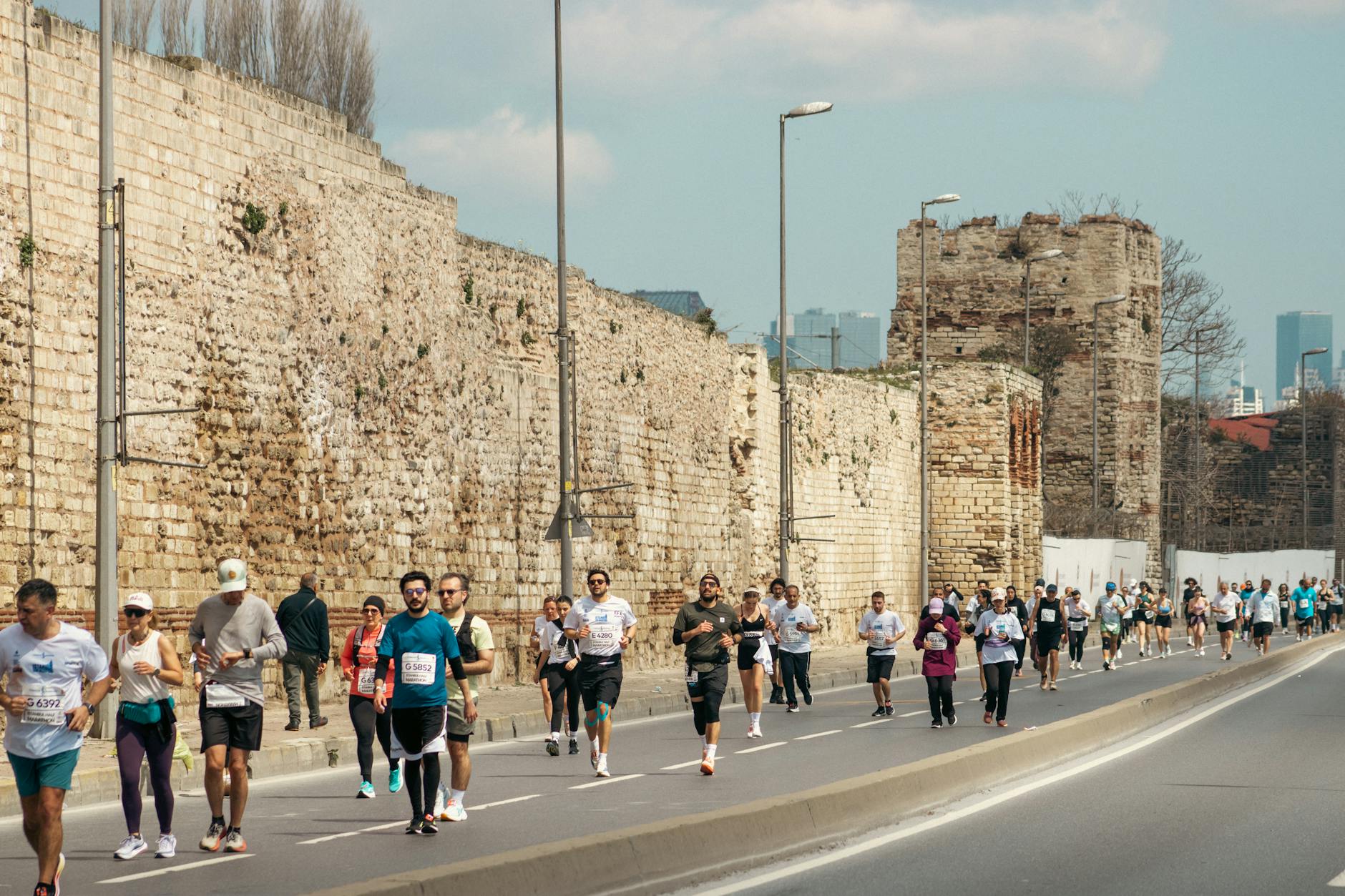
Photo by Semih Başaran on Pexels
You’re running well. Mile 18 feels manageable. Then, somewhere between mile 20 and 22, everything changes. Your legs stop cooperating. Your pace drops. Your brain starts sending you signals you’ve never felt mid-run — a heavy, hollow, almost desperate feeling. That’s the wall. And if you’ve hit it before, you’ll do almost anything to avoid it next time.
The good news: the wall isn’t random bad luck. It has a cause, and that cause is largely preventable. The bad news: preventing it requires decisions you make weeks before race day, not just on the morning itself.
This article is for runners who’ve hit the wall, or are worried they will. Not elite runners banking 100-mile weeks — but people training three or four days a week, squeezing in long runs on Sunday mornings, and hoping their preparation holds together on race day.
What actually causes the wall
The wall is primarily a fuel problem. Your body stores carbohydrate as glycogen — roughly 1,800–2,000 calories worth in your muscles and liver. At marathon pace, you burn through those stores in approximately 18–20 miles, depending on your size, speed, and how hard you’re running relative to your fitness level.
When glycogen runs low, your body has to shift toward fat as its primary fuel source. Fat burns slower and less efficiently. That’s the physiological reason your pace drops sharply and your legs feel like they’re full of wet cement.
There’s also a neurological component. Low blood sugar affects your brain, which is why the wall often brings a mental fog alongside the physical collapse. Research published in sports science literature has consistently shown that glycogen depletion impairs both motor function and cognitive performance — which is why runners make poor pacing decisions precisely when they need good ones most.
The number one cause: going out too fast
This is the one that gets most everyday runners. You’ve trained for months. Race day adrenaline is real. The first few miles feel easy. You bank some time. You tell yourself you’ll negative split later.
You won’t.
Going out even 10–15 seconds per kilometre too fast in the first half of a marathon dramatically accelerates glycogen depletion. You’re running at a higher intensity than your aerobic system can sustain, burning carbohydrate at a rate your fuelling strategy can’t match.
A simple rule: your first half should feel almost embarrassingly easy. If you’re running a 4:30 marathon (6:24/km), your first 10km should feel like a comfortable training run at around 6:20–6:30/km. Resist the crowd. Resist the downhills. Resist the feeling that you should be going faster. The race genuinely starts at mile 20.
How to fuel properly during the race
Most recreational runners underestimate how much carbohydrate they need during a marathon, or they take gels too late to make a difference.
Here’s a practical framework:
| Timing | What to take | Why |
|---|---|---|
| Morning of race (2–3 hrs before) | 60–90g carbs (porridge, toast, banana) | Top up liver glycogen overnight |
| 45–60 mins before start | Small carb snack (banana, gel) if needed | Keep blood sugar stable |
| Mile 6–7 (approx 50–55 mins in) | First gel or chews | Early fuelling before you need it |
| Every 30–40 minutes after | One gel (22–25g carbs) | Maintain carbohydrate availability |
| Mile 18–20 | Consider a caffeine gel | Caffeine can delay perceived fatigue |
The key word in that table is early. Taking your first gel at mile 13 because you feel fine is too late — your glycogen is already depleting, and gels take 15–20 minutes to hit your bloodstream.
Also: practise this in training. Every long run of 16 miles or more should be run with exactly the gels or chews you plan to use on race day. Gut issues mid-marathon are their own form of the wall.
Train your long runs properly
Hitting the wall is often a sign that your long runs weren’t long enough, or weren’t run at the right effort.
Your long run should be genuinely long — at least one run of 20 miles (or 32km) in the 10–12 weeks before race day, ideally two or three runs in the 18–20 mile range. Anything capped at 16 miles leaves you physically and mentally underprepared for the last 10km of a marathon.
Effort also matters. Long runs should sit at conversational pace — around 60–90 seconds per kilometre slower than your goal marathon pace. So if you’re targeting 5:00/km on race day, your long runs should mostly feel comfortable at 6:00–6:30/km. Going too hard on long runs depletes glycogen without building the aerobic adaptations you actually need.
If life gets in the way (it will), and you miss a long run, don’t try to compensate by running two back-to-back weekends of 20-milers in the final four weeks. Taper properly from three weeks out. A slightly undertrained runner who arrives at the start line fresh will outperform one who’s exhausted from last-minute panic training.
The role of carb loading — and what it actually means
Carb loading in the 24–48 hours before a marathon is legitimate, but most runners either skip it or do it wrong.
Carb loading isn’t eating a huge pasta dinner the night before. It’s systematically increasing your carbohydrate intake while reducing training load over the final two to three days — aiming for around 8–10g of carbohydrate per kilogram of body weight per day. For a 70kg runner, that’s 560–700g of carbs daily. That’s substantial, and it requires planning.
Focus on easily digestible carbs: white rice, pasta, bread, potatoes, bananas. Avoid high-fibre foods, heavy sauces, and anything your gut doesn’t already tolerate well. The goal is to arrive at the start line with glycogen tanks as full as they can be.
The NHS recommends a carbohydrate-rich diet in the days leading up to an endurance event, noting that it helps delay fatigue — though the guidance is general and individual needs vary.
Mental strategies when it gets dark anyway
Even with good fuelling and pacing, the last 10km of a marathon is hard. That’s not the wall — that’s just the marathon being a marathon. Knowing the difference matters.
True wall: sudden, dramatic pace collapse, disorientation, legs that won’t respond. Usually mile 18–22. Often preventable.
Late-race fatigue: steady grind, everything hurts, pace slips slightly. Mile 22–26. Completely normal.
When you’re in the late miles and it hurts, break the race into tiny chunks. Don’t think about the finish line. Think about the next mile marker. The next kilometre. The next corner. Experienced marathon runners aren’t positive — they’re practical. They’ve rehearsed telling themselves “this is supposed to be hard” without spiralling into “I can’t do this.”
Race day checklist to wall-proof your plan
Before you even get to the start line, make sure you have these confirmed:
- Pacing plan written down — your target splits per mile or 5km, with a reminder to hold back in the first half
- Gel schedule confirmed — know exactly when you’re taking each gel, which miles have water stations on the course
- Kit tested in training — shorts, shoes, socks, anti-chafe all worn on long runs before race day
- Carb loading started — 48 hours out, not just the night before
- Sleep expectation managed — two nights before matters more than the night before. Pre-race nerves will disrupt sleep on the Friday or Saturday night. That’s normal.
The Honest Takeaway
- The wall is caused by running out of glycogen — usually because you went out too fast, didn’t fuel early enough, or both. Fix the cause, not the symptom.
- Take your first gel at mile 6–7, not when you feel like you need one. By then, it’s already too late to fully recover.
- Your long runs need to be long enough. At least one 20-miler, run at conversational pace, with gels practised. There’s no shortcut here.
- Carb loading is real but requires two to three days of deliberate effort, not just a bowl of pasta the night before.
- Late-race suffering is not the wall — it’s just the marathon. Train yourself to distinguish between the two, and the last 10km becomes something you can grind through rather than something that surprises you.