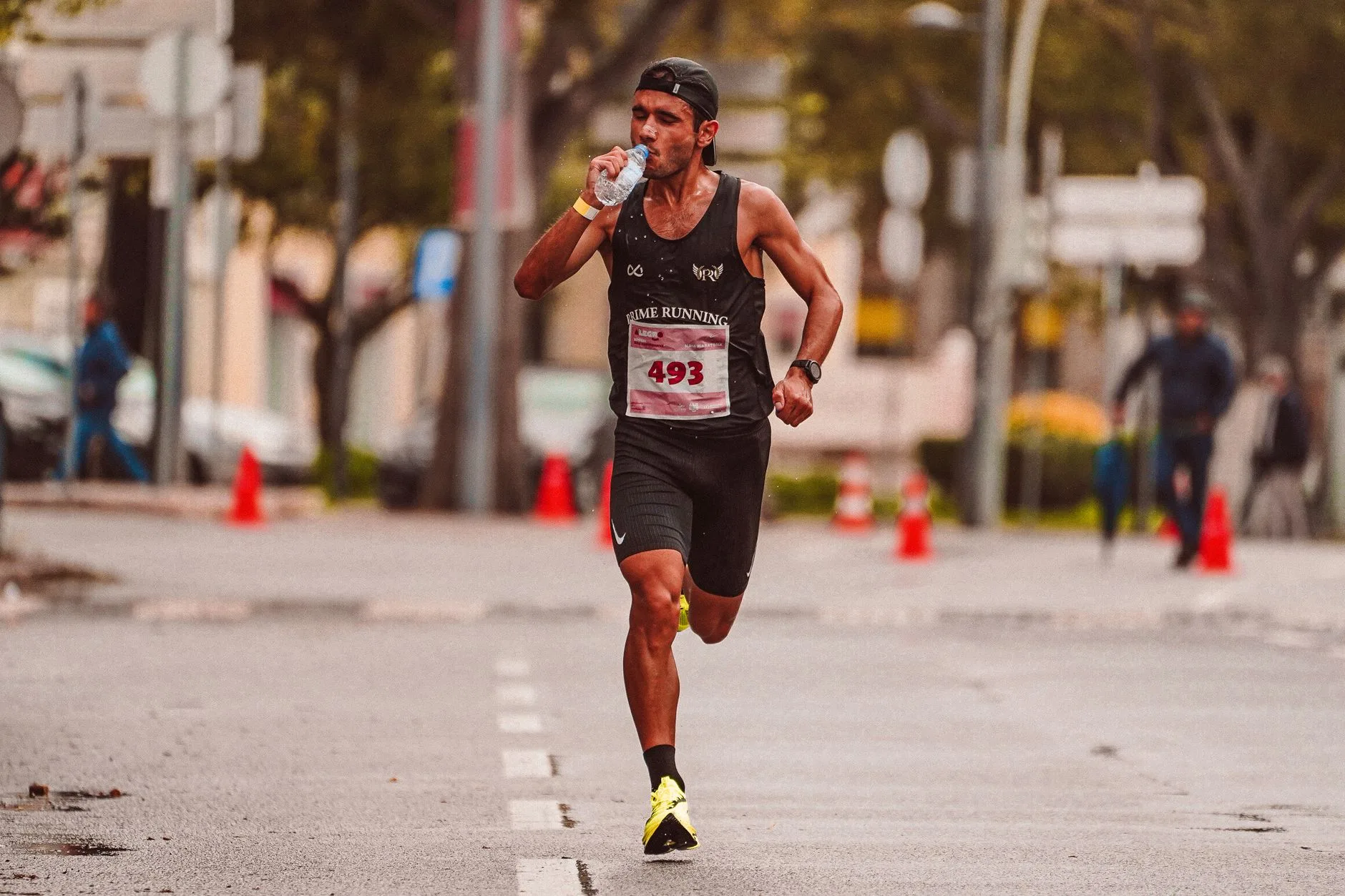
Photo by RUN 4 FFWPU on Pexels
You’ve done the long runs. You’ve hit 32km on tired legs on a Sunday morning when you’d rather have been asleep. And then race day arrives, and somewhere around mile 18 your legs go heavy, your pace drops without your permission, and you start wondering if this is just what marathons feel like.
Sometimes it is. But often — more often than people admit — it’s not fatigue in the muscular sense. It’s fuel. Your body has burned through its stored glycogen and you didn’t replace carbohydrate fast enough to keep up. The wall isn’t mysterious. It’s a fuel tank hitting empty, and it’s largely preventable with a plan you’ve actually practiced.
This isn’t about expensive gels or complicated science. It’s about a few numbers — grams of carbohydrate per hour, millilitres of fluid, timing — that you decide on weeks before race day, not mid-race when you’re already in trouble.
Why fueling matters more than most training runs suggest
Your body stores roughly 90–120 minutes’ worth of usable glycogen, depending on your size, training status, and how well you carb-loaded beforehand. Most everyday marathoners are running for 4 to 5.5 hours. Do the maths — there’s a gap, and that gap has to be filled by carbohydrate you eat and drink during the race.
This is different from a half marathon, where many runners can get away with minimal or no fueling because the race is often over before glycogen runs critically low. In a marathon, under-fueling isn’t a risk — for most four-plus-hour runners, it’s close to a certainty if you don’t plan for it. If you’re still building toward your first marathon, it’s worth reading about what race week nutrition should look like too, because the loading phase and the race-day plan work together, not separately.
The core number: carbs per hour, not “a gel every 5k”
The most common mistake is fueling by landmark — “I’ll take a gel at every 5k marker” — rather than by time and dose. Landmarks don’t account for how much carbohydrate is actually in what you’re taking, so you end up either under-fueling or taking gels randomly without a real target.
Current sports nutrition guidance, broadly consistent across coaching bodies, points to a target of 30–60g of carbohydrate per hour for most runners, with some well-trained and gut-trained runners pushing toward 60–90g/hour using a mix of glucose and fructose. For the everyday marathoner running 4–5.5 hours, aim for the lower-to-middle end of that range: 40–50g per hour is a sensible, well-tolerated starting point.
| Fuel source | Typical carbs | Notes |
|---|---|---|
| Standard energy gel | 20–27g | Most common; check label, brands vary |
| High-carb gel (e.g. 2:1 glucose-fructose) | 30–40g | Useful for hitting 60g+/hour without excess volume |
| Sports drink (500ml) | 25–35g | Also covers fluid and electrolytes |
| Banana (medium) | ~27g | Course aid stations sometimes offer these |
| Jelly babies/sweets (5–6 pieces) | ~15–20g | Cheap backup, easier on some stomachs |
If you’re taking a standard 25g gel every 30–35 minutes, you’re sitting around 45g/hour — a good, practical target. Round it to something you can remember on the course: gel at 30 minutes, then every 30–35 minutes after that, alongside water or sports drink at aid stations.
Build your plan backwards from your finish time
A 3:30 marathoner and a 5:15 marathoner need genuinely different plans — not just because of pace, but because the slower runner is out there longer and needs more total fuel, spread more carefully, with more attention to gut tolerance over time.
| Finish time | Race duration | Fuel stops (approx) | Total carbs taken |
|---|---|---|---|
| 3:15–3:45 | ~3.5–4 hrs | Gel every 35–40 min (5–6 gels) | ~150–180g |
| 4:00–4:30 | ~4–4.5 hrs | Gel every 30–35 min (7–8 gels) | ~180–220g |
| 4:45–5:30 | ~4.75–5.5 hrs | Gel every 30 min + extra sweets/banana | ~220–260g |
These are starting points, not laws. Bigger runners generally need more; smaller runners can often get away with slightly less. The point of the table is to show you that “just take a gel every 5k” badly underserves a 5-hour runner and risks overloading a fast one’s stomach if taken too densely early on.
Practice it exactly as you plan to race it
This is the part people skip, and it’s the part that causes most on-course disasters. Your gut has to be trained to absorb carbohydrate at pace, under jostling, with adrenaline affecting digestion — and that training happens on your long runs, not improvised on race morning.
Three to four weeks out, start rehearsing your exact plan on long runs: same gel brand, same timing, same approximate pace as goal race pace for at least part of the run. If a gel causes stomach cramping or a sudden urgent toilet need, you want to find that out on a Tuesday long run near home, not at mile 16 of your marathon.
This is also when you test sports drink concentration if the race provides one you haven’t used before — many UK marathons use a specific brand at aid stations, and it’s worth checking their flavour and concentration in advance so you’re not trying something new mid-race.
Hydration and electrolytes: separate from carbs, equally important
Fuel and fluid are related but not the same problem, and treating them as one leads to mistakes — like drinking too much water and diluting your sodium levels, or skipping fluid because you’re “doing gels.”
A rough guide: 400–800ml of fluid per hour, adjusted for heat, your sweat rate, and body size. Hotter conditions and heavier sweaters sit at the top end; cooler days and lighter sweaters nearer the bottom. You lose sodium in sweat too, and on a 4+ hour effort, plain water alone can leave you short — this is where electrolyte drinks or capsules earn their place, particularly if you’re prone to cramping in the later miles. The NHS has useful general guidance on staying hydrated during exercise if you want the basics confirmed.
If you tend to finish races feeling nauseous or bloated rather than simply tired, you may be over-drinking relative to your sweat rate — a genuinely common and under-discussed problem, not just under-fueling in disguise.
What to do when your stomach rebels mid-race
Even with a practiced plan, marathon day throws things your training runs didn’t: nerves, heat you didn’t train in, a slightly different gel handed out on course because yours didn’t arrive in your drop bag. Have a backup plan.
If gels start feeling impossible around mile 16–18 — a very common point for gut distress — switch to small, frequent sips of sports drink and small amounts of solid carbohydrate like jelly sweets if the course offers them. Slowing your pace by 10–15 seconds/km for a mile or two while you stabilise your stomach is a far better trade than pushing hard, vomiting, and losing much more time anyway.
Walking through an aid station — even for 15–20 seconds — to actually get fuel and fluid down properly, rather than fumbling a gel packet while running at pace, is not a failure. Plenty of 3:30 marathoners do exactly this and lose almost no real time doing it.
Your actual race-morning checklist
A good fueling plan falls apart if breakfast is wrong or you’re dehydrated before the gun even goes off. Three hours before the start, eat a carbohydrate-heavy breakfast you’ve tested before — porridge, toast with jam, a bagel — around 1–2g of carbohydrate per kg of bodyweight. Sip water steadily in the two hours before the start rather than chugging it in one go. And carry your first gel on you, rather than relying on finding it in a bag at the start line in the chaos of a UK marathon’s assembly area.
The Honest Takeaway
- Target 40–50g of carbohydrate per hour for most everyday marathoners — roughly a standard gel every 30–35 minutes — and adjust up or down based on your finish time and body size.
- Rehearse your exact fueling plan — same products, same timing — on at least 3–4 long training runs before race day. Race day is not the place to test a new gel.
- Treat hydration and electrolytes as separate from carb fueling: aim for 400–800ml of fluid per hour and don’t assume water alone covers your sodium needs on a hot day.
- If your stomach struggles mid-race, slow down and switch to sips and small solids rather than pushing through nausea — it costs you less time than it feels like it will.
- Build your fueling plan in the weeks before race day, not during carb-loading week — the two work together, so read up on how to carb-load properly as part of the same preparation, not a separate task.
Next read: Carbohydrate loading before a marathon: how to do it right