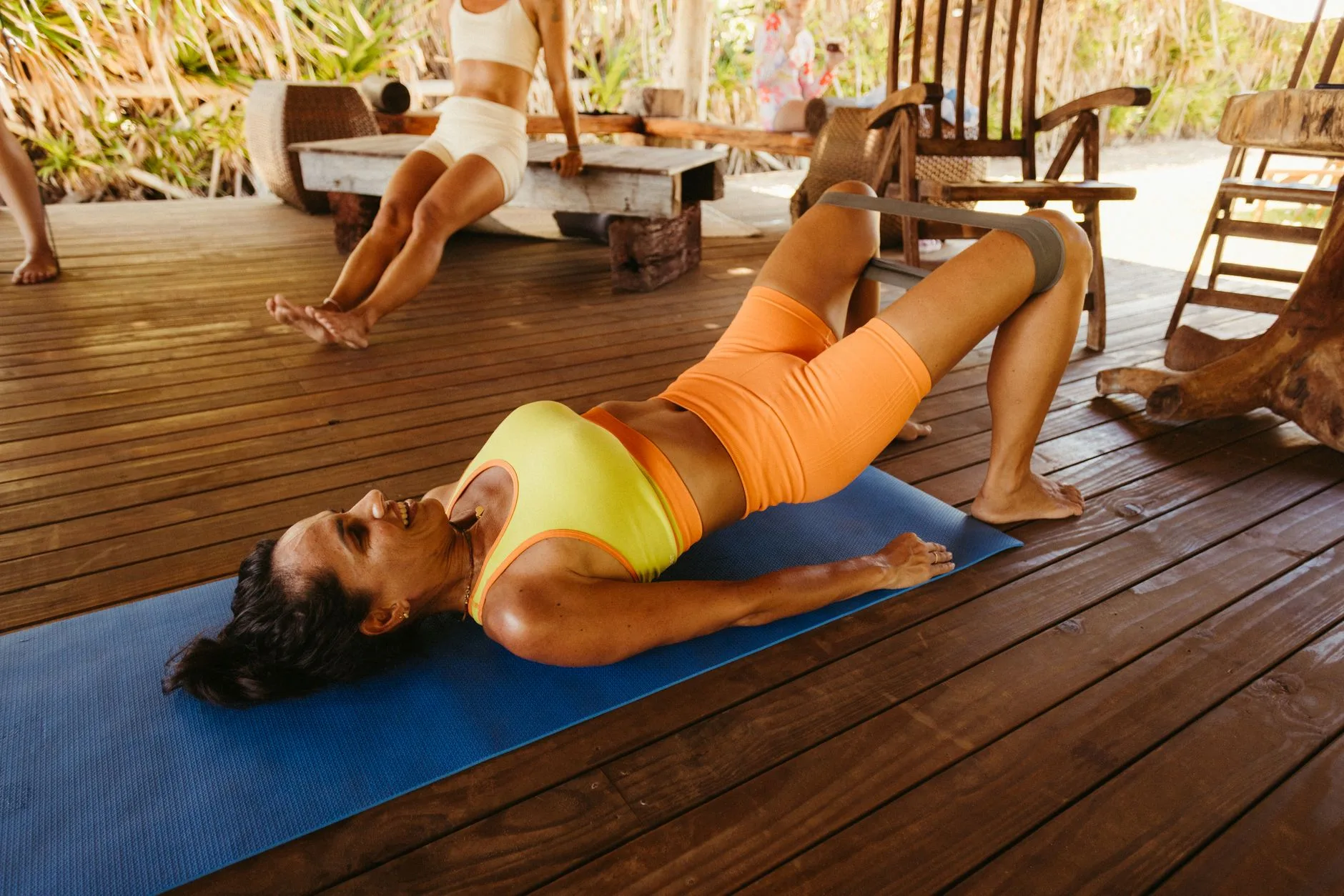
Photo by Jonathan Borba on Pexels
Your knee hurts on the outside, just below the kneecap, usually around mile 3 of every run. Or it’s your IT band. Or your hip flexor feels tight no matter how much you stretch it. You’ve foam rolled, you’ve bought new shoes, you’ve even tried running on softer surfaces. Nothing’s really fixed it.
There’s a decent chance the actual problem isn’t where the pain is. It’s what’s not firing a few inches away — your glutes. Specifically, glute medius and glute max, the muscles that stop your hip from collapsing inward every time your foot hits the ground. Most runners, especially those who sit at a desk for eight hours and then go run, have glutes that are “there” but not doing their job. Weak or lazy glutes don’t just mean a flat backside — they mean your knee, IT band, and hip take load they weren’t built to carry, run after run.
This isn’t about building a gym-honed backside. It’s about giving the muscle group that controls your hip stability enough strength and activation that it actually does its job for the 40–60 minutes you’re pounding pavement. Twice a week, 15–20 minutes, no gym membership required. Here’s what actually works.
Why glutes matter more than most runners think
Every time you run, you spend roughly 80–90% of the stride cycle balancing on one leg. Your glute medius is the muscle responsible for keeping your pelvis level during that single-leg phase — stopping your hip from dropping on the opposite side (what physios call a Trendelenburg pattern). If it’s weak, your hip drops, your knee drifts inward, and your IT band gets dragged over your femur thousands of times per run.
Glute max is different — it’s your main hip extensor, driving you forward and absorbing force when you land. Weak glute max often shows up as over-reliance on your hamstrings and calves, which is part of why so many runners get recurring calf tightness or hamstring strains that never quite resolve.
None of this is really controversial among physios who treat runners. The pattern — runner’s knee, IT band syndrome, and some hip pain cases — correlates strongly with poor hip abductor strength, and that’s reflected in how physiotherapists approach rehab for these conditions, per guidance from the NHS on managing knee pain. The fix isn’t complicated. It’s consistent, boring, unglamorous strength work.
The exercises that actually work (and the ones that don’t)
A lot of “glute activation” content online is bodyweight clamshells and nothing else. Clamshells have their place — but if that’s the ceiling of your glute work, you’re undertraining for what running actually demands, which includes high force, single-leg, dynamic movement.
Here’s a breakdown of what’s worth your time, split by what each one actually trains:
| Exercise | Targets | Sets x Reps | Why it matters for running |
|---|---|---|---|
| Glute bridge | Glute max | 3 x 15 | Builds base hip extension strength |
| Single-leg glute bridge | Glute max, pelvic control | 3 x 10 each side | Mimics single-leg stance of running gait |
| Clamshells | Glute medius (activation) | 2 x 15 each side | Good warm-up, not enough alone |
| Side-lying leg raises | Glute medius | 2 x 15 each side | Builds hip abduction strength |
| Lateral band walks | Glute medius, hip stability | 3 x 10 steps each direction | Directly trains the pattern that prevents knee collapse |
| Single-leg squats (to a box) | Glute max, quad, balance | 3 x 8 each side | Closest strength exercise to actual running mechanics |
| Romanian deadlifts (single-leg if possible) | Glute max, hamstrings | 3 x 8 each side | Builds posterior chain strength and balance |
| Step-ups (knee-height step) | Glute max, quads | 3 x 10 each side | Builds power for hills and finishing kicks |
If you only have time for three of these, pick single-leg glute bridges, lateral band walks, and single-leg squats. They cover activation, strength, and the single-leg balance demand that running actually places on your body — which bodyweight clamshells alone just don’t.
How to fit this into a week that’s already full
You don’t need a separate gym day. This works best bolted onto days you’re already running or resting.
- Twice a week, 15–20 minutes. More isn’t dramatically better here — consistency across weeks matters far more than volume in any single session.
- Do it after an easy run, not before a hard one. Fatiguing your glutes before a tempo run or long run will wreck your form and pace. Save strength work for easy run days or rest days.
- Pair it with your warm-up routine if you’re tight on time. A few of these — clamshells, band walks — double as activation drills before a run, not just standalone strength sessions. If you want a fuller pre-run routine, our guide on the best warm-up exercises before running covers how to layer this in without adding 20 extra minutes to your morning.
- Progress slowly. Add a resistance band to bridges and step-ups after 3–4 weeks, not before. Strength work for runners should build gradually — the goal is durability, not soreness.
If you’re also trying to build general strength and conditioning around running without turning it into a second sport, this overlaps a lot with what we cover in our piece on cross training for runners, which goes into how much non-running work actually helps versus what’s just noise.
How long before you notice a difference
Be honest with yourself about timelines here, because this is where people give up too early. Strength adaptations in small stabiliser muscles like glute medius generally take 4–6 weeks of consistent work before you notice a real shift — not in how your legs look, but in how your knees and hips feel on longer runs.
Week 1–2: exercises feel awkward, maybe sore in a new way.
Week 3–4: form improves, you can do single-leg squats without wobbling as much.
Week 5–6: this is usually when runners report less knee or IT band discomfort on runs over 8km.
If you’re currently dealing with pain, not just tightness, strength work is part of the fix but not the whole picture — you may need to adjust your running volume too. If it’s your Achilles rather than your knee bothering you, that’s a slightly different pattern worth reading up on separately, in our piece on Achilles tendinopathy and whether you can keep running.
Signs your glutes are the actual problem
Not every niggle is glute-related, so here’s a rough self-check:
- Your knee pain is on the outside of the knee, worsens on downhills, and improves with rest (classic IT band pattern)
- You notice one hip “drops” more than the other when you watch yourself run on video or a treadmill from behind
- You can’t do a single-leg squat to 90 degrees without your knee caving inward
- Your hamstrings or calves feel chronically tight despite stretching, which can be a sign they’re compensating for weak glutes
If none of that rings true and your pain is sharp, localised, or getting worse rather than better, that’s a different conversation — see a physio rather than guessing.
A simple 6-week progression to actually follow
| Week | Focus | Sessions/week |
|---|---|---|
| 1–2 | Learn form: bridges, clamshells, band walks | 2 |
| 3–4 | Add single-leg bridges, single-leg squats | 2 |
| 5–6 | Add resistance bands, step-ups, single-leg RDLs | 2–3 |
Keep each session to 15–20 minutes. This isn’t meant to replace your runs or compete with them for energy — it’s meant to make the runs you’re already doing hold up better.
The Honest Takeaway
- Do glute work twice a week, after easy runs or on rest days — not before hard sessions.
- Prioritise single-leg exercises (single-leg bridges, single-leg squats, lateral band walks) over passive ones like clamshells alone — they better match what running actually demands.
- Give it 4–6 weeks before judging whether it’s working. This is slow, unglamorous progress, not a quick fix.
- If pain is sharp, localised, or worsening rather than improving with rest, strength work alone won’t solve it — get it checked.
- Tomorrow morning, if you’re not running: 3 sets of 15 glute bridges and 3 sets of 10 lateral band walks each direction. That’s it. Fifteen minutes, no equipment beyond a resistance band.