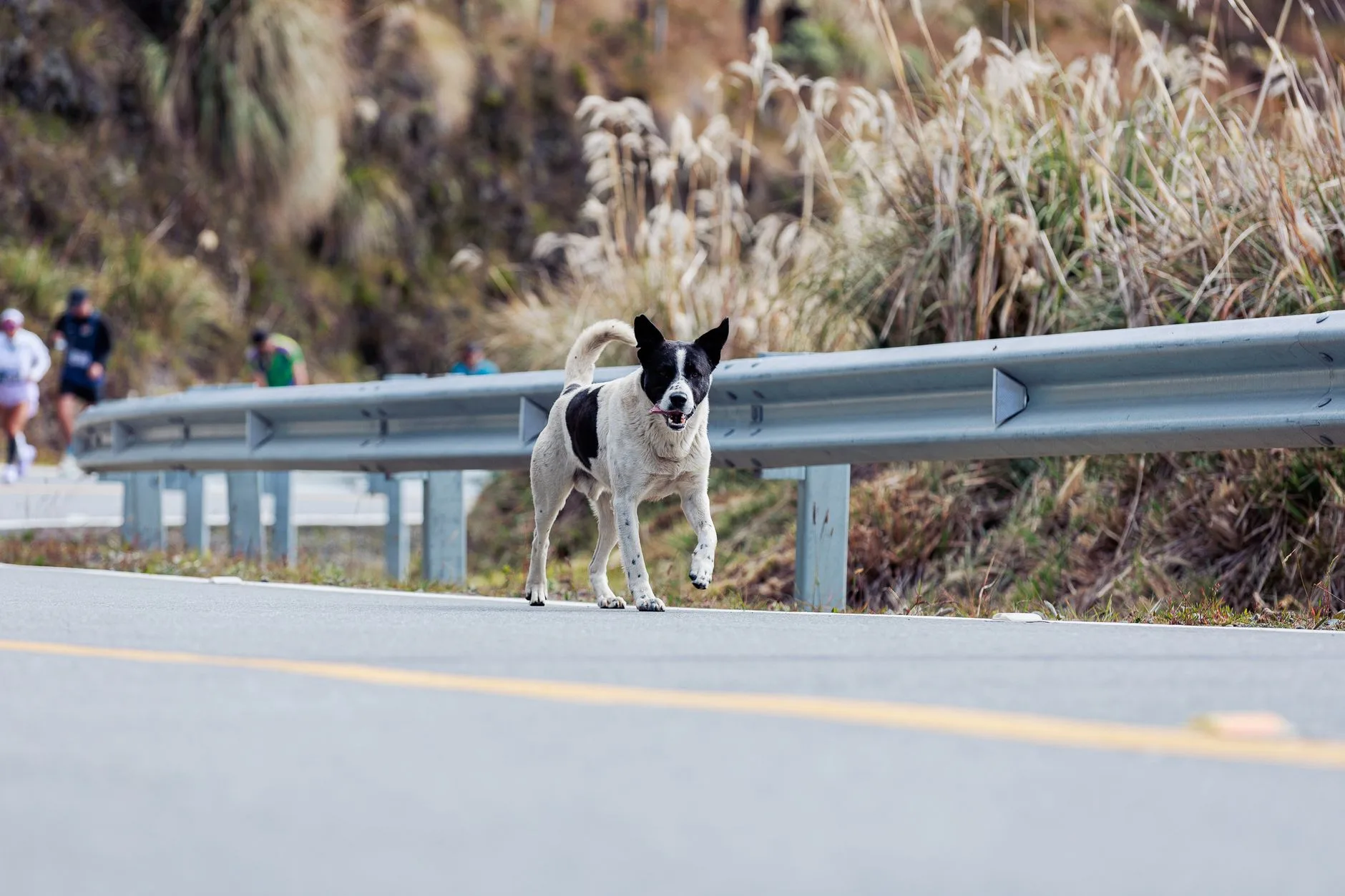
Photo by CRISTIAN CAMILO ESTRADA on Pexels
Your dog is faster than you, more excited than you, and has absolutely no concept of negative splits. That’s the honest starting point. Running with a dog isn’t a scaled-down version of solo running — it’s a different skill, and most of the injuries and bad days come from treating it like a leisurely jog with a lead attached rather than a partnership that needs its own rules.
Whether you’re pounding pavement on a Tuesday morning or heading onto muddy trails at the weekend, the fundamentals change depending on the surface. Road running with a dog is mostly about traffic management, pacing, and paw protection on hard ground. Trail running with a dog adds terrain unpredictability, wildlife encounters, and a much higher risk of your dog disappearing after a rabbit for four minutes while you stand there shouting a name that means nothing to them in that moment.
None of this means you need to overhaul your running life. It means being specific about a handful of things — pace, distance, kit, and recovery — the same way you would be for yourself.
Know your dog’s actual fitness, not the fitness you assume they have
Dogs don’t pace themselves. A young, motivated dog will run through discomfort to keep up with you, which means the “they seemed fine” test is not a safe one. Before you start any regular running routine with a dog, get a rough sense of two things: their skeletal maturity and their breed-typical exercise tolerance.
Puppies and young dogs (roughly under 12–18 months, depending on breed size — larger breeds mature later) shouldn’t be doing structured, sustained running on hard surfaces. Their growth plates are still closing, and repetitive pounding can cause joint problems later in life. This isn’t overcautious internet advice — it’s standard veterinary guidance, and the RSPCA’s exercise advice is a decent starting reference if you’re unsure about your specific dog.
Flat-faced breeds (bulldogs, pugs, boxers) generally shouldn’t be distance running partners at all — their airways aren’t built for sustained aerobic effort, especially in heat. Long-legged, lean breeds (vizslas, collies, most lurchers) tend to have high stamina but can overdo it because they genuinely don’t self-regulate. Older dogs need the same graded return-to-fitness thinking you’d apply to a human coming back after time off — start short, watch for stiffness the next day, and don’t assume last year’s fitness is still there.
Build mileage the way you’d build your own
This is the part most guides skip: treat your dog’s training load like you’d treat your own. If your dog has mostly been on lead walks, don’t take them out for a 10k on day one just because they seem keen. Increase distance by roughly 10% a week, same rule of thumb as human training, and give at least one full rest day between running days for the first month.
| Week | Human/dog run distance | Notes |
|---|---|---|
| 1–2 | 2–3km, easy pace | Mostly road, flat, check paws after |
| 3–4 | 3–4km | Introduce one trail session if terrain is manageable |
| 5–6 | 4–6km | Add gentle hills, watch recovery next morning |
| 7–8 | 6–8km | Longer trail runs okay if dog copes well with shorter ones |
If your dog is panting heavily, lagging behind, or lying down mid-route, that’s not stubbornness — that’s the same signal you’d respect in yourself. Stop, walk, reassess.
Road running with a dog: the specific stuff
Road runs are more predictable than trails, but they come with their own risks — mostly traffic, hard surfaces, and heat retention from tarmac.
Lead length and position matter more than people think. A standard 1.2–2m lead gives your dog room to find a natural stride without you constantly correcting them. Avoid retractable leads for running — they’re unpredictable at speed and can cause burns or falls if they snap taut. A hands-free running belt with a bungee-style lead is worth the investment if you’re running with a dog regularly; it stops shoulder strain and lets you keep your arm swing.
Check the pavement temperature before summer runs. If tarmac is too hot to hold your palm on for five seconds, it’s too hot for paw pads. Early morning or evening runs solve this in most of the UK’s warmer months. Heatstroke in dogs progresses fast and is genuinely dangerous — the PDSA’s guidance on exercising dogs safely is worth a read if you’re running through summer.
Traffic-side positioning: keep your dog on the inside, away from the road, and be deliberate at junctions — a dog that’s used to walks doesn’t automatically understand that running speed changes the timing of a crossing.
Trail running with a dog: what actually changes
Trails ask more of both of you. Uneven ground is genuinely good for building strength and proprioception in dogs (much like it is for us), but it also raises injury risk if your dog is unfit or the terrain is technical.
- Recall matters more than fitness. Before you let a dog off-lead on trails, their recall needs to be reliable around distractions — not just in the back garden. If it isn’t, a lead (ideally a longer trail-specific one, 2–3m) is the responsible option, even if it’s less convenient for you.
- Watch the ground, not just the view. Loose scree, tree roots, and hidden holes are a twisted-ankle risk for you and a soft-tissue injury risk for your dog. Slow down on technical sections — this isn’t the place to chase a pace target.
- Wildlife and livestock rules are non-negotiable. In the UK, dogs must be kept under control near livestock, and many farmers are within their rights to act if a dog is worrying sheep. Know the route before you go, particularly in spring lambing season.
- Water access isn’t guaranteed. Rivers and streams may look convenient but can carry bacteria (blue-green algae is toxic to dogs and appears in still water during warm months). Carry water for your dog rather than relying on natural sources — a soft flask or collapsible bowl fits easily in most running vests. If you’re already looking at kit for longer trail days, a well-fitted running backpack for long runs has room for dog water too.
Pacing: the conversation nobody has
Here’s the uncomfortable truth: your ideal training pace and your dog’s ideal running pace are rarely the same. Most dogs are more comfortable at a slightly faster pace than a typical human easy run — think 5:00–5:30/km territory for many medium-to-large breeds trotting comfortably, versus a human easy pace of 6:00–6:30/km. This mismatch is exactly why dogs pull, surge, and stop-start on runs: they’re trying to run at their pace, not yours.
The fix isn’t forcing your dog into your pace band every time. It’s accepting that a “run with the dog” day and a genuine training session are sometimes different things. If you’re deep into a structured plan — say a 12-week half marathon plan with specific pace targets — your dog run might need to be the easy day, not the tempo day, because holding your dog back or letting them drag you off pace defeats the point of a controlled session.
Recovery isn’t just for you
Dogs don’t complain about DOMS, but they get stiff, they get sore paw pads, and they can develop repetitive strain injuries from too much too soon — just like human runners chasing mileage too fast. After a longer or hillier run:
- Check paw pads for cuts, cracks, or embedded grit
- Offer water within a few minutes of finishing, not immediately mid-sprint-drink
- Watch for limping the next morning — a day off, not a return to normal, is the right call
- Keep nails trimmed; overly long nails change gait and increase joint stress on hard surfaces
If your dog seems consistently reluctant to start runs they used to enjoy, that’s worth a vet check before assuming it’s just laziness.
The Honest Takeaway
- Match the run to your dog’s actual conditioning, not their enthusiasm — enthusiasm doesn’t equal readiness.
- Use a fixed-length lead and hands-free belt for road runs; keep trail off-lead running reserved for dogs with genuinely reliable recall.
- Check surface temperature in summer and carry water on trails — don’t rely on streams or rivers.
- Accept that dog runs and structured training runs are sometimes different sessions, and that’s fine.
- If your dog is limping, reluctant, or slowing dramatically compared to their normal pattern, that’s a stop-and-check moment, not a push-through moment.
Next read: Hill training for runners: benefits and sessions that work